
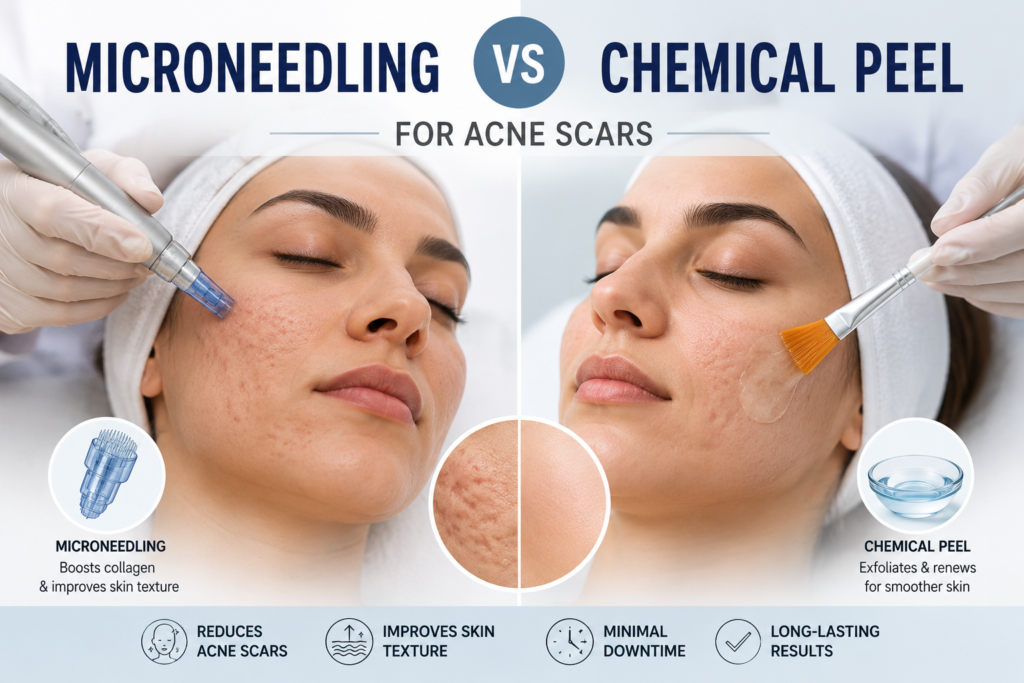
Acne scars can affect skin texture, tone, and confidence long after breakouts clear. When comparing Microneedling vs Chemical Peel, the best choice depends on the type of acne scars you have, your skin tone, your downtime preference, and whether your main concern is texture, dark marks, or both.
Both treatments can improve the look of acne scars, but they work in different ways. Microneedling focuses on collagen remodeling below the surface. Chemical peels focus on controlled exfoliation and skin renewal from the surface downward.
For many people, the right answer is not choosing one forever. It is choosing the right treatment at the right stage of the skin journey.
Microneedling vs Chemical Peel Comparison Table
Before looking at each treatment in detail, here is a clear comparison of how microneedling and chemical peels work for acne scars.
| Comparison Point | Microneedling | Chemical Peel |
| Main purpose | Improves skin texture by supporting collagen production | Improves surface tone, pigmentation, and skin renewal |
| Best for | Rolling scars, shallow boxcar scars, enlarged pores, uneven texture | Dark marks, dullness, clogged pores, mild acne marks, uneven tone |
| Skin layer targeted | Works deeper in the dermis | Works mainly on the surface, depending on peel depth |
| Typical downtime | Redness and sensitivity for 1 to 3 days | Light flaking to visible peeling depending on peel strength |
| Results timeline | Gradual improvement as collagen rebuilds over weeks | Skin may look brighter after peeling and renewal |
| Best treatment plan | Usually a series of sessions | Usually a series of peels or part of a combined plan |
A chemical peel may make skin look brighter faster. Microneedling may be better for long term improvement in depressed acne scars because it helps stimulate collagen remodeling.
What Causes Acne Scars?
Acne scars form when inflammation damages the skin’s natural healing process. Deeper acne lesions can affect collagen in the dermis, leaving dents, uneven texture, or raised areas. The most common acne scars are atrophic scars. These are depressed scars where collagen loss has created uneven skin texture. There are three main types of atrophic acne scars.
| Scar Type | How It Looks | Common Treatment Focus |
| Ice pick scars | Narrow, deep, sharp looking pits | Targeted resurfacing, TCA CROSS, combination care |
| Boxcar scars | Wider depressions with defined edges | Microneedling, peels, laser, collagen support |
| Rolling scars | Wave like uneven texture | Microneedling, subcision, collagen remodeling |
Dark marks after acne are not true scars. They are usually post inflammatory hyperpigmentation. Chemical peels may help these spots more directly than microneedling, especially when discoloration is the main concern.
How Microneedling Works for Acne Scars
Microneedling uses tiny sterile needles to create controlled micro channels in the skin. This process stimulates the skin’s natural repair response and supports new collagen and elastin formation. Collagen is important because many acne scars are caused by collagen loss.
By encouraging remodeling in the deeper layers of the skin, microneedling can gradually soften texture, improve shallow scars, and make the skin look smoother.
Microneedling is often chosen for rolling scars, mild to moderate boxcar scars, enlarged pores, and uneven texture. At World of Beauty, clients interested in skin texture improvement can learn more about microneedling treatment in Miami.
How Chemical Peels Work for Acne Scars
Chemical peels use exfoliating acids to remove damaged outer skin layers and promote new skin turnover. The depth of the peel depends on the acid type, strength, skin condition, and professional technique. Common peel ingredients include glycolic acid, salicylic acid, lactic acid, Jessner solution, and trichloroacetic acid, often called TCA.
Light peels are usually used for uneven tone, clogged pores, dull skin, and mild post acne marks. Medium depth peels may help more visible discoloration and some texture concerns, but they require more downtime and careful aftercare.
Chemical peels are often useful when the main issue is pigmentation, surface roughness, active congestion, or mild acne related marks. You can review professional peel options here: chemical peels in Miami.
What Research Says About Acne Scar Treatments
Clinical studies show that microneedling and chemical peels can both improve acne scars, but results depend heavily on scar type, skin type, technique, and treatment depth.
One clinical comparison found microneedling produced better outcomes than 35 percent glycolic acid peels for acne scar treatment in patients with Fitzpatrick skin types IV to VI.
Research on chemical peels shows that superficial peels are often used for acne, mild discoloration, post inflammatory pigmentation, and skin radiance. TCA CROSS has also been studied for selected ice pick scars.
| Research Finding | What It Means for Acne Scars |
| Microneedling produced treatment efficacy in 73.33 percent of patients in one study, compared with 33.33 percent for 35 percent glycolic acid peels | Microneedling may be stronger for certain atrophic acne scars |
| Superficial chemical peels are commonly used for acne, mild discoloration, and post inflammatory pigmentation | Peels may be especially useful when dark marks and uneven tone are the main concern |
| TCA CROSS has shown meaningful improvement in selected ice pick acne scars in clinical literature | Deep narrow scars may need targeted peel based methods |
| Combination treatments are often used because acne scarring can include several scar types | A customized plan may work better than one treatment alone |
This is why professional evaluation matters. Acne scarring is rarely one single problem. Many people have a mix of rolling scars, boxcar scars, enlarged pores, dark marks, and active breakouts.
Which Is Better for Acne Scars?
For true acne scars with uneven texture, microneedling is often the stronger option. This is especially true when scars are shallow to moderate and caused by collagen loss. Microneedling works below the surface, where collagen rebuilding matters most. For dark marks, discoloration, dullness, and clogged pores, chemical peels may be more suitable.
Peels can improve surface tone and help fade post acne pigmentation over time. They can also support clearer skin by helping with oil buildup and congestion. If someone has both texture and dark marks, a combined treatment plan may be more effective than choosing only one.
Best Choice by Skin Concern
Different acne scar concerns need different treatment strategies. The table below gives a practical starting point.
| Skin Concern | Better Starting Option | Reason |
| Rolling acne scars | Microneedling | Supports collagen remodeling |
| Boxcar scars | Microneedling or combination care | Texture often needs deeper stimulation |
| Ice pick scars | Targeted peel methods or advanced scar treatment | Deep narrow scars need focused correction |
| Dark marks after acne | Chemical peel | Targets surface pigmentation and cell turnover |
| Dull skin and clogged pores | Chemical peel | Improves exfoliation and skin clarity |
| Mixed scars and discoloration | Combination plan | Different concerns need different methods |
This table should not replace a skin consultation. It simply shows why scar type matters before choosing a treatment.
Downtime and Recovery
Microneedling usually causes redness, warmth, tightness, and mild sensitivity. Many people look flushed for 24 to 72 hours. Chemical peel downtime depends on peel depth. A light peel may cause mild dryness or flaking.
A stronger peel may cause visible peeling for several days. Both treatments require sun protection. This is not optional. UV exposure after treatment can increase the risk of irritation and pigmentation.
For Miami clients, this matters even more because sun exposure is frequent. Daily sunscreen and proper aftercare are essential for safer results.
Safety for Different Skin Tones
Microneedling is often considered suitable for a wide range of skin tones when performed correctly. Chemical peels can also be safe for many skin tones, but peel selection must be careful.
Darker skin tones may have a higher risk of post inflammatory hyperpigmentation if the peel is too aggressive or aftercare is poor. This does not mean darker skin cannot have chemical peels. It means the peel type, strength, prep, and recovery plan must be chosen carefully.
A licensed professional should evaluate skin tone, sensitivity, acne activity, medications, and history of pigmentation before treatment.
How Many Sessions Are Needed?
Most acne scar treatments require a series. One session can help, but acne scars usually need repeated collagen stimulation or repeated exfoliation cycles.
| Treatment | Common Plan | When Results May Appear |
| Microneedling | 3 to 6 sessions depending on scar severity | Gradual improvement over several weeks |
| Light chemical peels | 3 to 6 treatments depending on concern | Often after peeling and renewal |
| Medium peels or targeted peels | Varies by skin type and scar depth | Progressive improvement with downtime |
| Combination plan | Customized schedule | Often better for mixed scars and marks |
The number of sessions should not be guessed. It should be based on scar type, healing response, skin tone, and realistic goals.
Can You Combine Microneedling and Chemical Peels?
Yes, but they should not be stacked carelessly. Some clients benefit from alternating treatments. For example, microneedling may be used for texture while chemical peels are used between sessions for pigmentation and skin clarity. The timing matters. Doing too much too soon can irritate the skin and increase the risk of barrier damage or pigmentation.
A professional treatment plan can space services properly and adjust based on how your skin responds. If your skin also needs cleansing, hydration, or calming care between corrective treatments, a facial service in Miami may help support overall skin health.
Who Should Avoid These Treatments?
Microneedling may not be suitable for people with active inflamed acne, open wounds, certain skin infections, poor wound healing, or recent isotretinoin use unless cleared by a qualified provider.
Chemical peels may not be suitable for people with certain skin conditions, active irritation, recent sunburn, pregnancy related restrictions depending on peel ingredients, or a history of poor healing.
Both treatments require a consultation if you are using retinoids, acne prescriptions, exfoliating acids, or photosensitizing medications. The wrong treatment at the wrong time can make skin worse. This is where many people go wrong with acne scar treatment.
Final Verdict: Which One Should You Choose?
Choose microneedling if your main concern is depressed acne scars, uneven texture, rolling scars, or mild to moderate boxcar scars.
Choose a chemical peel if your main concern is discoloration, post acne marks, dullness, clogged pores, or uneven tone.
Choose a combination plan if you have both texture and pigmentation. The best treatment is the one that matches your scar type, skin tone, healing ability, and goals.
For acne scars, microneedling often has the advantage for texture because it supports collagen remodeling. Chemical peels are valuable for surface renewal, brightness, and pigmentation.
Together, they can be powerful when used with the right timing and professional care. If you are unsure which treatment fits your skin, schedule a consultation through World of Beauty Miami to review your acne scars and choose a plan based on your skin, not guesswork.
2 Responses