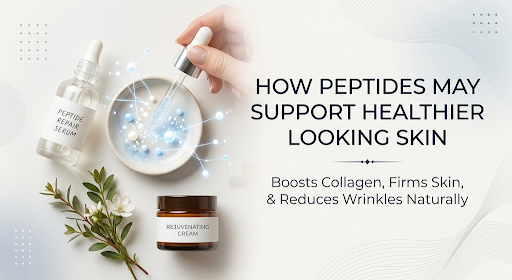
Peptides may support healthier looking skin by helping influence processes involved in the skin’s structure, hydration, and appearance. These short chains of amino acids are used in many skincare formulations, and research has investigated their potential role in improving visible signs of skin aging, including wrinkles, dryness, and uneven texture.
Peptides are not a single ingredient with one universal effect. Different peptides can have different biological functions, and the results depend on the specific peptide, formulation, concentration, delivery method, and individual skin characteristics.
What Are Peptides?
Peptides are short chains of amino acids, which are the building blocks of proteins. The skin naturally contains proteins such as collagen and elastin that contribute to its structure, firmness, and elasticity.
In skincare, peptides are included in topical products because certain peptide sequences may interact with skin cells or support processes associated with the extracellular matrix. Researchers commonly classify cosmetic peptides according to their proposed functions, including signal peptides, carrier peptides, enzyme inhibitor peptides, and neurotransmitter related peptides.
Understanding this distinction is important because not every peptide product works in the same way. Evidence for one peptide should not automatically be applied to every product that contains peptides.
How Peptides May Support Skin Health
The potential benefits of peptides are mainly associated with visible skin quality and signs of aging. Research has examined outcomes such as hydration, wrinkles, brightness, elasticity, and overall skin appearance.
A 2026 systematic review and meta analysis evaluated 19 randomized controlled trials involving 1,341 participants. The researchers found that peptide treatments were associated with improvements in hydration and brightness, while the overall effect on wrinkle reduction was modest.
| Research finding | Reported result |
| Randomized controlled trials reviewed | 19 |
| Total participants | 1,341 |
| Participants receiving oral collagen peptides | 1,236 |
| Participants receiving topical collagen formulations | 105 |
| Mean participant age | 50.2 years |
| Overall wrinkle reduction | Modest improvement |
| Skin hydration | Significant improvement in the review |
| Skin brightness | Significant improvement in the review |
The review also found that improvements in elasticity and skin density were less consistent. This suggests that peptides may have useful applications in skincare, but they should not be presented as a universal solution for every sign of aging.
Peptides and Collagen
Collagen is one of the major structural proteins in the skin. As people age, collagen production and the organization of the extracellular matrix change, contributing to visible alterations such as wrinkles and reduced firmness.
Some cosmetic peptides are designed to act as signal peptides or otherwise interact with processes associated with the extracellular matrix. Laboratory and clinical research has investigated whether these ingredients can support the appearance of aging skin.
It is important to distinguish cosmetic peptide products from collagen itself. Applying a peptide cream does not simply replace lost collagen, and the effectiveness of a product depends on its specific formulation and ability to reach the relevant layers of skin.
Peptides and Skin Hydration
Healthy looking skin depends partly on maintaining adequate moisture within the outer skin layers. Dehydrated skin can appear rough, dull, or more visibly lined.
The 2026 systematic review found a significant improvement in skin hydration among the peptide treatments evaluated. Oral polypeptides appeared to contribute substantially to this finding, although the researchers noted that more standardized research is needed.
For everyday skincare, peptides can therefore be considered one component of a broader routine. Moisturizers, gentle cleansing, and regular sun protection remain important parts of maintaining the skin barrier and appearance.
Peptides and the Appearance of Wrinkles
Wrinkles develop through a combination of intrinsic aging, repeated facial movement, environmental exposure, and changes in the skin’s structural components.
Certain peptide formulations have been investigated for their ability to improve the appearance of fine lines and wrinkles. However, results vary considerably between peptide types and formulations.
One recent randomized controlled trial examined a specific cyclized hexapeptide called CHP9. The study included adults with aging skin who used the peptide formulation twice daily for 56 days. Researchers reported reductions in several measures of crow’s feet and forehead wrinkles compared with the control formulation.
This result is interesting, but it should not be interpreted as evidence that every peptide product produces the same outcome. The study evaluated one specific formulation under controlled conditions.
Peptides and Skin Brightness
Uneven or dull looking skin can be influenced by sun exposure, dehydration, aging, inflammation, and other factors.
The 2026 systematic review found that peptide treatments produced a significant improvement in skin brightness. The pooled analysis reported a mean difference of 2.40 for brightness, although the researchers emphasized the need for additional high quality studies.
Because pigmentation can have many causes, peptides should not automatically be considered a treatment for every type of discoloration. Persistent pigmentation concerns may require a professional assessment to determine the underlying cause and the most appropriate approach.
Topical Peptides Compared With Oral Peptides
Peptides can be delivered in different ways, and this distinction matters when interpreting research.
Topical peptides are applied directly to the skin through products such as creams and serums. Oral collagen peptides are consumed as supplements and undergo digestion before their components enter the body.
The 2026 review included both approaches, but the evidence was weighted heavily toward oral collagen peptides. Of the 1,341 participants included in the analysis, 1,236 received oral collagen peptides while 105 received topical collagen formulations.
| Peptide approach | What research has examined |
| Topical peptides | Wrinkles, texture, hydration, and visible skin aging |
| Oral collagen peptides | Hydration, wrinkles, brightness, elasticity, and other skin measures |
| Specific peptide formulations | Targeted effects based on the individual peptide |
This difference in the amount of available research means findings from oral collagen supplements should not automatically be used to make claims about topical peptide creams.
What the Research Says About Evidence Quality
Peptide skincare has attracted considerable scientific interest, but the evidence base is still developing.
A 2019 systematic review identified 15 independent clinical studies involving cosmetic peptides. Only six used a placebo control, while five used double blinding, and nine studies included female participants only. The authors concluded that the available literature had important methodological limitations and that better controlled clinical trials were needed.
More recent research has expanded the evidence base. The 2026 systematic review included randomized controlled trials and found measurable improvements in several outcomes, while still calling for larger studies with standardized methods.
This is why it is more accurate to say peptides may support healthier looking skin rather than claiming they can reverse aging or guarantee a particular result.
Who May Consider Peptide Skincare?
Peptide based skincare may appeal to people who want to support their routine while addressing visible concerns such as dryness, fine lines, or uneven texture.
A peptide product can be incorporated into a broader skincare routine depending on the formulation and individual skin needs. Before adding a new product, checking its ingredients and following the manufacturer’s directions is important.
People with persistent irritation, significant pigmentation, active skin conditions, or unusual changes should consider professional evaluation rather than relying on a cosmetic ingredient alone.
Peptides as Part of a Broader Skincare Routine
Peptides work best when considered as one part of overall skin care rather than an isolated solution.
Daily sun protection is particularly important because ultraviolet exposure contributes significantly to premature skin aging. A broad skincare routine can also include gentle cleansing and appropriate moisturization based on individual skin needs.
Professional treatments may provide another option for people who want to address texture or other visible concerns. For example, microneedling treatment is a professional procedure that uses controlled skin punctures to stimulate a wound healing response and is commonly used to improve the appearance of certain scars, wrinkles, and skin texture concerns.
Chemical exfoliation is another approach that can address selected surface skin concerns. Chemical peel treatments use carefully selected chemical solutions to exfoliate layers of skin, with the appropriate treatment depending on the individual’s skin and goals.
For people interested in maintaining their skin with professional care, facial services can also be incorporated into a personalized skincare approach.
What to Look for in a Peptide Product
Not all peptide products are formulated in the same way. The ingredient list, peptide type, concentration, supporting ingredients, packaging, and overall formulation can all influence how a product performs.
| Factor | Why it matters |
| Specific peptide | Different peptides have different proposed functions |
| Formulation | Affects stability and delivery |
| Supporting ingredients | May contribute to hydration and skin comfort |
| Packaging | Can help protect sensitive ingredients |
| Consistent use | Allows enough time to evaluate visible changes |
It is also useful to avoid judging a product solely by the word peptide on its label. A formula should be evaluated as a whole, since other ingredients and the overall formulation can influence the skin’s response.
Are Peptides Safe for Skin?
Topical cosmetic peptides have generally been well tolerated in the clinical studies reviewed, although individual reactions are possible. The 2026 systematic review reported minimal adverse events across the included trials.
However, tolerance depends on the complete product formulation rather than the peptide alone. A person can react to another ingredient in a serum or cream even when the peptide itself is well tolerated.
It is also important not to confuse topical cosmetic peptides with injectable peptide products. Injectable or compounded peptide products can have different regulatory and safety considerations, and some specific compounded peptides have been identified by the FDA as presenting safety concerns or having limited human safety information.
How Long Does It Take to Notice Results?
Skincare changes generally take time, and peptide products should not be expected to transform the skin immediately.
Clinical studies have evaluated peptide products over periods ranging from several weeks to longer treatment periods. For example, the 2025 randomized trial involving CHP9 evaluated twice daily use for 56 days and reported measurable changes during that study period.
Individual results can vary because of age, skin condition, product formulation, consistency of use, sun exposure, and other aspects of a person’s skincare routine.
Frequently Asked Questions
Can peptides improve the appearance of fine lines?
Some peptide formulations have demonstrated improvements in wrinkle measurements in clinical studies. However, results vary by peptide and product, so evidence from one formulation should not be generalized to every peptide product.
Do peptides increase collagen?
Certain peptides are designed to interact with processes associated with the extracellular matrix and collagen production. However, saying that every peptide product directly increases collagen in the skin would be an oversimplification.
Are peptides better than other skincare ingredients?
There is no single skincare ingredient that is universally best for everyone. Peptides can be useful within an appropriate skincare routine, while other ingredients may be better supported for particular concerns.
Can peptides replace sunscreen?
No. Peptides and sunscreen serve different purposes. Sun protection remains an important part of reducing ultraviolet exposure and protecting the skin from photoaging.
How often should peptide skincare be used?
The appropriate frequency depends on the specific product and its instructions. Some formulations are designed for daily use, while others may have different recommendations.
Final Thoughts
Peptides may support healthier looking skin by contributing to improvements in hydration, brightness, and the appearance of wrinkles. Current research is encouraging, but the strength of evidence varies considerably between different peptide types and delivery methods.
The most recent systematic review of randomized controlled trials included 19 studies and 1,341 participants and found significant improvements in hydration and brightness, along with a modest overall effect on wrinkle reduction. At the same time, researchers noted inconsistencies in outcomes such as elasticity and called for larger, better standardized studies.
For that reason, peptides are best viewed as one part of a complete approach to skin care. A consistent routine, sun protection, appropriate professional treatments, and products selected according to individual skin needs can all contribute to maintaining healthier looking skin over time.
For more information about professional skincare options and available treatments, visit the World of Beauty Miami.