
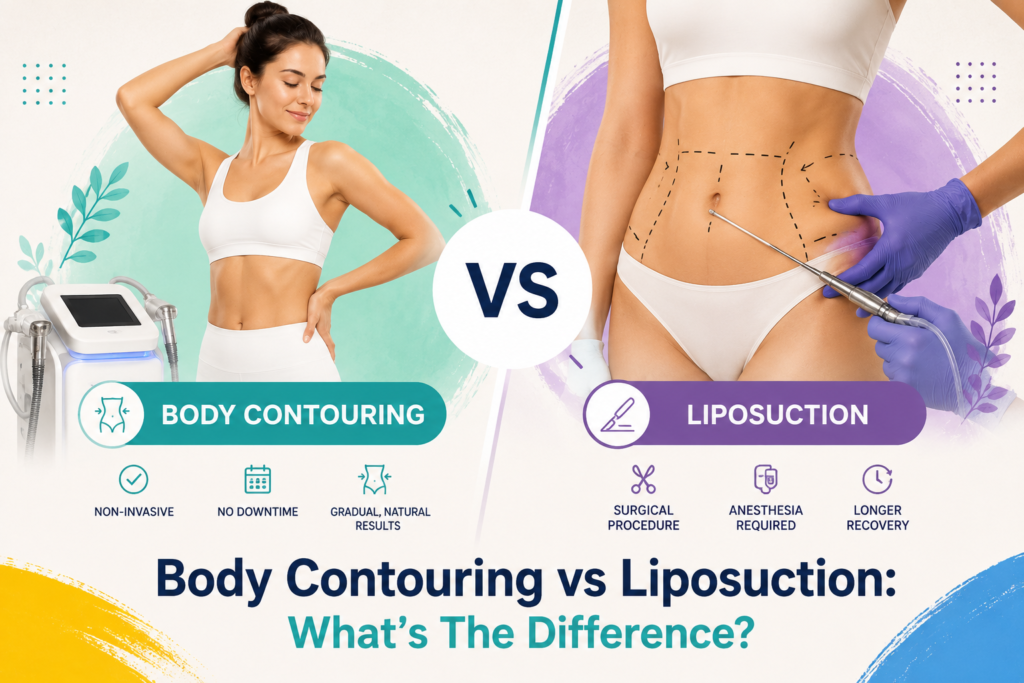
When comparing Body Contouring vs Liposuction, the biggest difference is the method used to reshape the body. Liposuction is a surgical procedure that removes fat through small incisions. Nonsurgical body contouring uses external technologies or specialized techniques to improve the appearance of selected areas without surgically removing fat.
Both options can help improve body proportions, but they are not interchangeable. They differ in treatment intensity, recovery time, expected results, risks, cost, and suitability. Understanding these differences can help you choose an option that matches your goals, lifestyle, health, and expectations.
What Is Body Contouring?
Body contouring is a broad category of treatments intended to improve the shape and appearance of specific areas of the body. These treatments may target small pockets of fat, uneven contours, cellulite, skin texture, or areas that lack visible definition.
Body contouring can include surgical procedures, but the term is often used to describe nonsurgical treatments offered at beauty studios and aesthetic practices.
According to the United States Food and Drug Administration, nonsurgical body contouring may use cooling, heat, ultrasound energy, light, massage, or other forms of energy. The exact purpose and effect depend on the technology being used.
At World of Beauty Miami, clients can explore aesthetic treatments intended to enhance their natural shape without undergoing cosmetic surgery.
Nonsurgical body contouring may be used on areas such as:
- Abdomen
- Waist
- Hips
- Thighs
- Upper arms
- Back
- Legs
- Buttocks
It is important to understand that body contouring is not a weight loss treatment. The FDA states that nonsurgical contouring does not treat obesity, produce meaningful weight loss, or provide the health benefits associated with losing weight.
Its purpose is cosmetic improvement rather than medical weight management.
What Is Liposuction?
Liposuction is a cosmetic surgical procedure that physically removes fat from targeted areas of the body. During the procedure, a plastic surgeon makes small incisions and inserts a thin tube called a cannula beneath the skin. The cannula is connected to suction equipment that removes fat from the treatment area.
Liposuction may be performed on the:
- Abdomen
- Waist and flanks
- Hips
- Thighs
- Back
- Upper arms
- Chest
- Neck
- Chin
Depending on the treatment plan, liposuction may require local anesthesia, sedation, or general anesthesia. The procedure must be performed in an appropriate medical setting by a qualified professional.
Liposuction can remove a greater amount of localized fat during one procedure than most nonsurgical treatments. However, it is not an obesity treatment or a substitute for healthy eating and regular physical activity.
Liposuction also does not automatically correct loose skin, cellulite, stretch marks, or muscle separation. Skin elasticity plays an important role in the final appearance because the skin must adapt to the new contours after fat has been removed.
Body Contouring vs Liposuction at a Glance
| Comparison | Nonsurgical Body Contouring | Liposuction |
| Treatment type | Nonsurgical cosmetic treatment | Cosmetic surgery |
| Incisions | No surgical incisions | Small incisions are required |
| Anesthesia | Usually not required | Local anesthesia, sedation, or general anesthesia may be used |
| Fat removal | Does not suction fat from the body | Physically removes fat through suction |
| Expected change | Usually gradual and subtle | Usually more noticeable |
| Number of treatments | Several sessions may be recommended | Often completed in one operation |
| Recovery | Little or no interruption to normal activities for many clients | A postoperative recovery period is required |
| Results | Develop gradually and vary by technology | Become clearer as surgical swelling decreases |
| Main risks | Depend on the device and treatment method | Include surgical and anesthesia related risks |
| Best suited for | Modest refinement without surgery | More substantial localized fat reduction |
How Do Body Contouring Treatments Work?
Different body contouring treatments work in different ways. There is no single method used by every provider.
Some technologies apply controlled ultrasound energy. Others use heat, cooling, light, radiofrequency, mechanical massage, or vacuum assisted techniques. Certain treatments are intended to influence fat cells, while others focus more on skin texture, circulation, muscle appearance, or temporary circumference reduction.
For example, cavitation treatments use ultrasound based technology as part of a nonsurgical approach to localized body shaping.
A professional should explain the exact device or method being recommended. Clients should understand what the treatment is designed to do, whether the device has been cleared for that purpose, how many sessions may be required, and what side effects are possible.
The FDA advises consumers to discuss the benefits, risks, expected duration of results, and possibility of complications before receiving nonsurgical body contouring.
How Does Liposuction Work?
Liposuction removes fat through suction rather than relying on the body to process treated cells gradually.
The surgeon first marks the areas that will be treated. Anesthesia is administered according to the surgical plan. Small incisions are then made near the target area, and a cannula is moved through the layer of fat beneath the skin.
The amount of fat that can be removed safely depends on several factors, including:
- The patient’s health
- The number of areas being treated
- The surgical technique
- The treatment setting
- The surgeon’s assessment
- Whether other procedures are being performed
After surgery, compression garments may be recommended to support the treated tissues and control swelling.
Although some changes may be visible soon after the procedure, swelling can temporarily hide the final result. The contour normally becomes clearer as the body heals.
Which Option Produces More Noticeable Results?
Liposuction generally produces a more noticeable reduction in localized fat because the fat is physically removed during surgery.
Nonsurgical body contouring usually creates a more modest change. It may be useful for someone who has a relatively small area of concern and does not want surgery, anesthesia, or an extended recovery period.
The American Society of Plastic Surgeons explains that nonsurgical fat reduction can offer an alternative for people who are unwilling or unable to undergo surgery. However, these treatments are not replacements for liposuction.
The better option depends on the amount of change a person wants.
Someone seeking subtle refinement may prefer nonsurgical contouring. A person seeking more substantial fat removal may need to consult a qualified plastic surgeon about liposuction.
Body Contouring and Liposuction Statistics
Liposuction remains one of the most frequently selected cosmetic surgeries in the United States.
The American Society of Plastic Surgeons reported that almost 350,000 liposuction procedures were performed during 2023. This represented a 7 percent increase compared with 2022.
The organization’s 2024 report also ranked liposuction as the most popular cosmetic surgical procedure.1
| Verified Statistic | Reported Finding |
| Liposuction procedures in 2023 | Almost 350,000 |
| Increase from 2022 to 2023 | 7 percent |
| Position among cosmetic surgeries in 2024 | Most popular cosmetic surgical procedure |
| Primary purpose of nonsurgical contouring | Cosmetic body shaping rather than weight loss |
| Typical nonsurgical treatment goal | Reduction or refinement of small, localized concerns |
These figures demonstrate the continued demand for body shaping procedures. They do not mean that liposuction is suitable for everyone or that every patient will achieve the same result.
Recovery After Body Contouring
One of the main reasons people choose nonsurgical body contouring is the limited recovery period.
Many clients can return to work or normal daily activities soon after treatment. However, the experience depends on the device, treatment intensity, target area, and individual response.
Possible temporary effects may include:
- Redness
- Tenderness
- Swelling
- Bruising
- Numbness
- Tingling
- Firmness
- Temporary discomfort
The FDA also notes that some devices can cause pain, burns, blisters, lumps, skin color changes, or other complications. The type of risk depends on the technology being used.
Nonsurgical does not mean risk free. Treatment should still be provided by a properly trained professional who understands the device, appropriate settings, contraindications, and safety protocols.
Recovery After Liposuction
Liposuction requires a structured recovery period because it is surgery.
Patients may experience swelling, bruising, soreness, numbness, and fluid drainage during the early healing stage. Compression garments are commonly recommended to support the treated areas and help manage swelling.
The time required to return to work varies. A person who has a small area treated may return sooner than someone who has several areas treated. Jobs involving lifting, exercise, or prolonged physical activity may require a longer break.
Patients must follow their surgeon’s instructions concerning:
- Wound care
- Medication
- Compression garments
- Bathing
- Physical activity
- Driving
- Exercise
- Follow up appointments
Final results should not be judged immediately. Swelling may continue to improve over several weeks or months.
Risks of Body Contouring vs Liposuction
Every cosmetic procedure carries some level of risk.
Nonsurgical body contouring risks depend heavily on the device and treatment method. A treatment that uses cooling has different possible complications from one that uses heat, ultrasound, massage, or radiofrequency.
Certain technologies may be unsuitable for people who are pregnant or who have implanted medical devices, circulation disorders, skin infections, sensitivity to temperature, nerve conditions, or other health concerns.
Liposuction carries surgical risks. Mayo Clinic lists possible complications including contour irregularities, fluid accumulation, numbness, infection, internal injury, fat embolism, kidney or heart problems, and reactions to anesthesia.
The likelihood of complications may increase when larger areas are treated or when liposuction is combined with additional operations.
A qualified surgeon should review the patient’s medical history, medications, smoking status, previous procedures, allergies, and expectations before recommending surgery.
Who Is a Good Candidate for Body Contouring?
A suitable candidate for nonsurgical body contouring may be someone who:
- Is near a stable body weight
- Has a small area they would like to refine
- Prefers to avoid cosmetic surgery
- Understands that results may be subtle
- Can attend multiple sessions when necessary
- Has realistic expectations
- Does not have a medical contraindication
- Is willing to maintain healthy lifestyle habits
Nonsurgical body contouring may also be useful for people who cannot take significant time away from work or family responsibilities.
A personalized consultation is important because treatment should be selected according to the target area, tissue characteristics, skin condition, health history, and desired result.
Clients can explore customized body contouring programs to learn how an individualized treatment plan may address specific cosmetic concerns.
Who Is a Good Candidate for Liposuction?
Liposuction may be appropriate for a person who:
- Has localized fat that has not responded to lifestyle changes
- Wants a more noticeable contour change
- Is healthy enough to undergo surgery
- Has realistic expectations
- Has reasonably elastic skin
- Can follow postoperative instructions
- Can allow enough time for recovery
- Understands the possible surgical risks
Smoking can interfere with healing and increase the risk of complications. A surgeon may require a patient to stop smoking before and after surgery.
People with serious medical conditions, poor circulation, uncontrolled diabetes, significant heart or lung disease, or an increased risk of blood clots may not be appropriate candidates.
Only a qualified medical professional can determine whether liposuction is reasonably safe for a specific person.
Are the Results Permanent?
The answer depends on the procedure, the technology, and future lifestyle changes.
Fat cells removed through liposuction do not return. However, the remaining fat cells can become larger if the patient gains weight. Weight gain may also occur in treated and untreated areas, changing the overall result.
Some nonsurgical fat reduction technologies permanently damage or remove a portion of the treated fat cells. Other body contouring services may produce temporary changes in appearance, fluid movement, skin texture, or circumference.
The FDA advises that the results of nonsurgical body contouring may be temporary and may require more than one treatment. It also states that the desired effect is not guaranteed.
Long term maintenance may depend on:
- Stable body weight
- Regular physical activity
- Balanced nutrition
- Hydration
- Skin quality
- Hormonal changes
- Aging
- Pregnancy
Neither treatment prevents future changes in the body.
Does Either Treatment Tighten Loose Skin?
Liposuction primarily removes fat. It does not automatically remove a significant amount of loose skin.
A person with firm, elastic skin may see the skin adapt more smoothly after fat removal. Someone with reduced elasticity may experience loose, uneven, or rippled skin after surgery.
Nonsurgical treatments vary. Some technologies are intended to support a firmer appearance, but results depend on the amount of looseness and the specific method used.
Severe excess skin may require evaluation by a plastic surgeon. A skin removal procedure may be more appropriate when the concern is hanging or significantly stretched skin rather than localized fat.
What About Cellulite?
Cellulite and excess fat are different concerns.
Cellulite occurs when fat pushes against connective tissue beneath the skin, creating a dimpled or uneven appearance. A person can have cellulite even when they have a healthy weight and relatively little excess fat.
Liposuction is not a reliable cellulite treatment and may sometimes make surface irregularities more noticeable.
Some nonsurgical contouring treatments may temporarily improve the appearance of cellulite by influencing tissue texture, circulation, or the structures beneath the skin. Results vary, and several sessions may be necessary.
Clients should clearly explain whether their main concern is fat, cellulite, loose skin, muscle tone, or general body shape. Each concern may require a different approach.
How to Choose Between Body Contouring and Liposuction
Consider the following questions before deciding:
| Question | Body Contouring May Suit You When | Liposuction May Suit You When |
| How much change do you want? | You want subtle refinement | You want a more noticeable reduction |
| Do you want surgery? | You prefer a nonsurgical option | You are comfortable considering surgery |
| Can you manage recovery time? | You need minimal interruption | You can allow time for healing |
| How quickly do you want treatment completed? | You can attend multiple sessions | You prefer one main procedure |
| Are you prepared for anesthesia? | You would rather avoid it | You accept the need for surgical anesthesia |
| What is your primary concern? | A small localized area | A larger pocket of removable fat |
| What level of risk are you comfortable with? | You prefer lower treatment intensity | You understand and accept surgical risks |
Before making a final decision, review real treatment examples while remembering that every body responds differently. The World of Beauty gallery can provide visual context for discussing your preferences during a consultation.
Questions to Ask During Your Consultation
A good consultation should provide clear, specific answers.
Ask the provider:
- What exact treatment or device will be used?
- What is the treatment intended to improve?
- Is it appropriate for my target area?
- How many sessions might I need?
- When should I expect to notice a change?
- How long could the result last?
- What side effects are common?
- What complications are possible?
- What qualifications and training do you have?
- What should I do before and after treatment?
- Is there a reason I should not receive this treatment?
- What alternative treatment might suit me better?
Anyone considering liposuction should also ask about the surgical facility, anesthesia provider, recovery plan, emergency procedures, and the surgeon’s relevant credentials.
Final Verdict
The main difference in Body Contouring vs Liposuction is simple. Liposuction is surgery that physically removes fat. Nonsurgical body contouring uses external technologies or specialized techniques to improve the appearance of targeted areas without surgical fat removal.
Liposuction generally offers a more noticeable change, but it requires incisions, anesthesia, medical recovery, and acceptance of surgical risks.
Nonsurgical body contouring is more appropriate for people seeking modest refinement with little interruption to daily life. Results usually develop gradually, and multiple sessions may be recommended.
Neither option is a weight loss treatment. Neither can guarantee a specific shape, perfectly smooth skin, or permanent protection from future weight gain.
The right choice depends on your health, target area, skin quality, desired degree of change, recovery preferences, budget, and tolerance for risk. A detailed consultation with an appropriately qualified provider is the safest way to develop realistic expectations and select a suitable treatment.