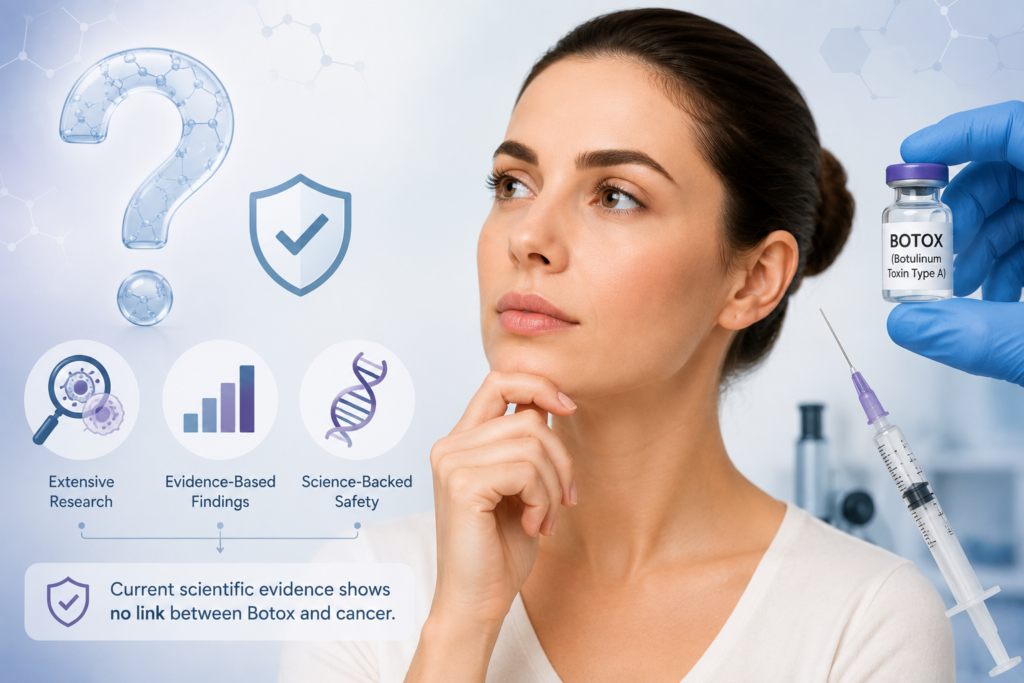
If you are asking can botox cause cancer, the most accurate answer is reassuring. Current medical evidence does not show that Botox causes cancer when it is used correctly by a licensed, trained provider.
Botox Cosmetic is an FDA regulated prescription treatment made with onabotulinumtoxinA. It is used to temporarily improve the look of certain facial lines, including frown lines, crow’s feet, forehead lines, and platysma bands.
This question matters because Botox is made from a toxin, and the word toxin can sound frightening. But cancer risk is not based on the name of a product. It is based on whether a substance damages DNA, causes harmful cell changes, or creates evidence of cancer in research and real world use.
For people considering wrinkle relaxing treatments, World of Beauty offers professional Botox and Dysport in Miami with a focus on safe, natural looking cosmetic results.
Quick answer
Botox has not been proven to cause cancer. Cancer is not listed as a known risk in standard Botox Cosmetic warnings, and the main safety concerns are related to toxin spread, swallowing problems, breathing problems, allergic reactions, and use in people with certain nerve or muscle conditions.
The FDA label also states that long term animal studies have not been performed to evaluate the carcinogenic potential of Botox Cosmetic. However, Botox Cosmetic was negative in several genetic toxicology tests, including tests used to look for mutation related concerns.
So the balanced answer is this: there is no proven cancer link, but Botox should still be treated as a prescription medical product that requires qualified care.
What Botox is
Botox is a purified form of botulinum toxin type A. In cosmetic medicine, it is injected into specific muscles to temporarily reduce muscle activity.
Wrinkles such as forehead lines, frown lines, and crow’s feet often form because the same facial muscles contract again and again over time. Botox relaxes targeted muscles, which can soften the appearance of these expression lines.
This effect is temporary. Over time, nerve signals recover and muscle movement gradually returns, which is why many patients repeat treatment every few months.
Why people worry about cancer
Many people hear “botulinum toxin” and wonder whether it could harm the body in a deeper way. That concern is understandable, especially when the treatment is placed into the face or neck.
Cancer, however, develops through changes in genes that control how cells grow and divide. The National Cancer Institute describes cancer as a genetic disease caused by changes that affect normal cell function, especially growth and division.
That means the cancer question should focus on evidence. Does Botox damage DNA? Does it cause mutations? Does it make cells grow uncontrollably? Does research show higher cancer rates in Botox users?
At this time, the available evidence does not show that Botox causes cancer.
Table 1: What science says about Botox and cancer
| Question | What current evidence says | What it means for patients |
| Does Botox have a proven cancer link? | No proven causal link has been established in humans. | Botox is not considered a known cancer causing cosmetic treatment. |
| Is cancer listed as a known Botox risk? | Cancer is not listed as a main warning or common adverse reaction in prescribing information. | The recognized risks are mainly related to toxin effects, not cancer. |
| Has Botox been tested for mutation risk? | Botox Cosmetic was negative in several genetic toxicology tests. | This is reassuring because DNA mutation is one pathway connected with cancer risk. |
| Have long term animal cancer studies been done? | Long term animal studies have not been performed to evaluate carcinogenic potential. | This is why responsible medical content should avoid claiming absolute certainty. |
| Is Botox detected widely in the bloodstream after recommended doses? | At recommended intramuscular doses, Botox is not expected to be detected in peripheral blood with current technology. | This supports the idea that properly injected Botox acts mainly in the treatment area. |
What the FDA label actually says
The prescribing information is one of the most important sources for understanding Botox safety. It does not identify cancer as a known Botox risk.
The same label does include serious warnings about distant spread of toxin effect. This means botulinum toxin effects may spread from the injection area and cause symptoms such as weakness, double vision, drooping eyelids, trouble speaking, trouble swallowing, and trouble breathing.
These warnings should be taken seriously. They are also different from cancer risk.
For cosmetic use at recommended doses, Botox Cosmetic safety information focuses on correct dosing, proper injection technique, medical screening, and avoiding use in unsafe settings.
Does Botox damage DNA?
Based on FDA referenced toxicology information, Botox Cosmetic was negative in a group of genetic toxicology tests. These tests included in vitro and in vivo assays used to evaluate mutation related risk.
This does not mean any medical product can be described as risk free. It does mean that available mutation testing has not shown a genetic toxicity signal for Botox Cosmetic.
That point matters because many cancer causing substances work by damaging DNA or increasing mutation risk. Current Botox data does not support that concern.
What about long term Botox use?
Many cosmetic patients receive Botox for years. Current evidence does not show that repeated Botox treatments cause cancer.
Long term use should still be managed carefully. The more practical concerns are over treatment, unnatural results, changes in facial balance, cost, and the possibility that some patients may develop reduced response over time.
The Botox Cosmetic label notes that antibody formation has been observed in studies, although neutralizing antibodies were not found in the lateral canthal line trials discussed in the label.
A skilled injector usually aims for the lowest effective dose and appropriate spacing between treatments. This helps protect both safety and natural facial movement.
Table 2: Botox use statistics
| Statistic | Number | Why it matters |
| United States neuromodulator injection patients in 2024 | 9,883,711 | Neuromodulators remained one of the most common minimally invasive cosmetic treatments. |
| United States growth from 2023 to 2024 | 4 percent | Demand continued to rise year over year. |
| Worldwide botulinum toxin procedures in 2024 | 7.8 million | ISAPS reported botulinum toxin as the most common nonsurgical procedure among plastic surgeons worldwide. |
| Most common global nonsurgical procedure | Botulinum toxin | This shows the treatment has a large international safety experience. |
| Common global age group for botulinum toxin in the ISAPS report | 35 to 50 years | This age group had the highest number of botulinum toxin procedures in the 2024 survey. |
ASPS reported 9,883,711 neuromodulator injection patients in the United States in 2024, a 4 percent increase from 2023.
ISAPS reported 7.8 million botulinum toxin procedures by plastic surgeons worldwide in 2024, making it the most common nonsurgical procedure in its global survey.
Large numbers do not prove that a treatment has no risk. They do show that Botox and similar neuromodulators have been widely used and closely watched in cosmetic medicine.
What risks are actually linked with Botox?
The real risks of Botox are not mainly cancer related. They are related to how the medicine affects nerves and muscles.
Possible serious symptoms can include trouble swallowing, trouble breathing, severe weakness, voice changes, and vision problems. These effects are uncommon in cosmetic use at appropriate doses, but they require urgent medical attention if they occur.
More common cosmetic side effects are usually milder. These can include headache, eyelid drooping, brow drooping, swelling, bruising, tenderness, and temporary asymmetry.
Table 3: Common Botox Cosmetic side effects by treatment area
| Treatment area | Commonly reported side effect | Reported rate |
| Frown lines between the eyebrows | Eyelid drooping | 3 percent |
| Crow’s feet | Eyelid swelling | 1 percent |
| Forehead lines | Headache | 9 percent |
| Forehead lines | Brow drooping | 2 percent |
These side effect rates come from Botox Cosmetic prescribing information. They are treatment area specific, which is one reason technique and dose planning are so important.
A careful consultation should review your medical history, medications, allergies, previous cosmetic treatments, and expectations before any injection is performed.
Counterfeit Botox is a bigger concern than cancer
When people ask whether Botox is dangerous, counterfeit products deserve serious attention. The main risk is not that approved Botox causes cancer. The bigger concern is unsafe, fake, diluted, mishandled, or illegally administered botulinum toxin.
In 2024, the CDC reported harmful reactions linked to counterfeit or mishandled botulinum toxin injections. Some people received products from unverified sources, and some injections were given by people who were not following state or local requirements.
The FDA also warned that counterfeit versions of Botox had been found in multiple states. Reported symptoms included blurred or double vision, difficulty swallowing, dry mouth, shortness of breath, weakness, and difficulty lifting the head.
This is why cheap injections from unknown sources are not worth the risk. Genuine product sourcing, sterile technique, correct dosing, and proper medical training matter.
Who should be cautious before Botox?
Botox may not be appropriate for everyone. People with certain nerve or muscle disorders can be more sensitive to botulinum toxin effects.
Patients with conditions such as myasthenia gravis, Lambert Eaton syndrome, amyotrophic lateral sclerosis, swallowing problems, breathing problems, or a history of severe allergic reactions should discuss risks carefully with a qualified medical professional.
Pregnant or breastfeeding patients should also speak with a medical provider. In many cosmetic settings, elective treatment is delayed when the benefit is not medically necessary.
How to make Botox safer
Choose a licensed provider who uses genuine, FDA approved products from authorized suppliers. Ask what product is being used, where it came from, and why the dose is appropriate for your face.
Avoid Botox parties, home injections, hotel room treatments, and extremely low prices that seem unrealistic. Safe cosmetic medicine needs proper training, clean technique, quality supplies, and emergency awareness.
You should also avoid injecting too often. Good Botox does not mean freezing every muscle. It means softening targeted movement while preserving expression.
Patients who want a broader view of available aesthetic options can explore professional injectables services and discuss which treatment fits their goals.
Botox and fillers are not the same
Botox and dermal fillers are often discussed together, but they work differently. Botox relaxes muscle activity. Fillers restore or add volume.
Botox is often used for expression lines. Fillers are often used for volume loss, facial contouring, lips, cheeks, smile lines, and under eye concerns.
Neither treatment should be chosen only because it is popular. The best choice depends on your anatomy, skin quality, age, goals, and medical history.
Table 4: Botox compared with fillers
| Feature | Botox | Dermal fillers |
| Main action | Temporarily relaxes targeted muscle activity | Adds or restores facial volume |
| Common use | Frown lines, forehead lines, crow’s feet, neck bands | Lips, cheeks, folds, contouring, volume loss |
| Typical result | Softer expression lines | Fuller or more contoured appearance |
| Best for | Dynamic wrinkles caused by movement | Static lines, hollows, and volume changes |
| Cancer concern | No proven cancer causing link | Depends on product type, but FDA approved fillers are also regulated medical products |
This distinction helps prevent confusion. If a person has volume loss, Botox alone may not create the desired result. If a person has strong muscle movement, filler alone may not address the cause of the line.
What a good Botox consultation should include
A safe Botox visit should start with questions, not injections. Your provider should ask about your health history, medications, allergies, previous treatments, pregnancy status, and aesthetic goals.
They should also assess your facial movement. This includes how your brows lift, how your eyes smile, how your forehead moves, and whether one side naturally sits higher than the other.
A good plan explains dose, placement, expected timeline, possible side effects, and when to follow up. Results usually appear gradually rather than instantly.
When to call a provider after Botox
Mild redness, swelling, or small bruises can happen after injections. These effects often settle quickly.
Contact your provider if you notice unusual eyelid drooping, significant asymmetry, increasing pain, signs of infection, rash, or symptoms that feel unusual for you.
Seek urgent medical help for trouble breathing, trouble swallowing, severe weakness, difficulty speaking, or vision changes. These symptoms are uncommon but important.
Final verdict
So, can Botox cause cancer? Based on current FDA labeling, genetic toxicology information, clinical safety data, and available medical literature, Botox has not been proven to cause cancer.
The most accurate conclusion is balanced. Botox is not considered a known carcinogen, and available mutation testing has not shown a genetic toxicity signal. At the same time, long term animal carcinogenicity studies have not been performed, so no responsible source should claim impossible certainty.
For most healthy adults, the bigger safety issues are product authenticity, injector training, correct dosing, sterile technique, and proper screening.
If you are considering Botox in Miami, schedule a consultation with a qualified provider who can review your goals and health history. You can contact World of Beauty to ask questions and learn whether Botox or another aesthetic treatment is right for you.
Frequently asked questions
Can Botox cause cancer?
No proven evidence shows that Botox causes cancer when used correctly. Cancer is not listed as a known Botox Cosmetic risk in standard prescribing information.
Is Botox toxic to the body?
Botox is made from botulinum toxin type A, but cosmetic treatment uses controlled, purified, prescription doses. The safety depends on correct product, correct dose, correct placement, and a trained provider.
Can Botox spread in the body?
Botox labeling includes a warning that toxin effects may spread from the injection site. This can cause serious symptoms in rare cases, including trouble swallowing or breathing.
Is long term Botox safe?
Many people use Botox repeatedly over time, and current evidence does not show that long term cosmetic Botox causes cancer. Long term treatment should still be planned conservatively and medically supervised.
What is the biggest Botox safety risk?
One of the biggest avoidable risks is receiving counterfeit, unverified, or mishandled products from unlicensed or poorly trained injectors. CDC and FDA warnings have specifically addressed harmful reactions linked to counterfeit or mishandled botulinum toxin injections.