
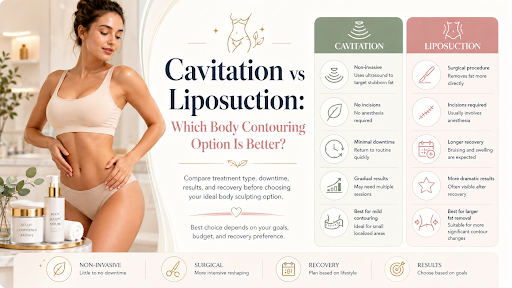
The question “Cavitation vs Liposuction: Which Body Contouring Option Is Better?” has no single answer because the treatments solve different versions of the same concern.
Cavitation suits people seeking a modest change without incisions or surgical recovery, while liposuction suits people who want a more substantial reduction in localized fat and accept anesthesia, healing time, and surgical risk.
Both are body contouring methods rather than weight loss treatments. The right choice depends on fat volume, skin elasticity, health, goals, and tolerance for recovery.
What Is Cavitation?
In this comparison, cavitation means external therapeutic ultrasound used for nonsurgical body contouring. Sound energy is delivered through the skin and reaches the fat layer beneath it, where certain authorized devices are intended to disrupt fat cells and reduce circumference in a treated area.
No incision is created and no tissue is suctioned from the body. The FDA states that noninvasive contouring may reduce small areas of excess fat, but it does not treat obesity or provide the health benefits of weight loss.
People exploring ultrasonic cavitation in Miami can expect a consultation focused on the treatment area, comfort, goals, and recommended number of sessions. The service page identifies the abdomen, waist, thighs, hips, arms, and back as common target areas and explains that results vary with body type, lifestyle, consistency, and the selected treatment plan.
What Is Liposuction?
Liposuction is surgery that removes localized fat through small incisions with a narrow tube called a cannula and suction. It can be used on areas such as the abdomen, waist, back, hips, thighs, buttocks, upper arms, chin, and neck.
Because fat is physically removed, the procedure can create a larger and more direct contour change. It may be performed alone or with another operation.
Liposuction is not a treatment for obesity, a substitute for nutrition and exercise, or a reliable cellulite treatment. Skin that is firm and elastic generally reshapes better than skin that is thin, lax, or significantly affected by weight change or aging.
Cavitation and Liposuction Compared
These are typical differences, not promises. Results vary with the device, treatment area, anatomy, and provider.
What Do the Statistics Show?
Liposuction has more extensive procedure data than cosmetic cavitation. The American Society of Plastic Surgeons recorded 349,728 procedures in 2024, a 1 percent increase from 2023.
The same report counted 1,585,878 cosmetic surgical procedures in 2024. Based on those figures, liposuction represented about 22 percent of the reported cosmetic surgery total, which helps explain why it ranked first among cosmetic operations that year.
Research on aesthetic ultrasound is smaller and depends heavily on the exact device and protocol. A 2014 prospective study enrolled 20 women and reported mean reductions after five ultrasound sessions of 1.5 centimeters at the waist, 2.1 centimeters at the abdomen, and 1.9 centimeters at the umbilical measurement.
The sample was small, treatment related symptoms were reported, and the authors called for more research. The figures should not be treated as a universal prediction.
Which Option Produces a Bigger Change?
Liposuction usually offers the greater contour change because the surgeon can physically remove a planned amount of subcutaneous fat. This makes it more suitable when a person wants a clearly visible reduction that is unlikely to be achieved through a gentle external treatment.
Cavitation is better understood as refinement. The FDA describes noninvasive contouring devices as options that may decrease small amounts of excess fat, and it warns that results may be temporary or may not match the desired effect.
Cavitation should not be expected to reproduce a surgical result. Its smaller change may still suit someone who strongly prefers to avoid incisions.
Which Option Has Less Downtime?
Cavitation generally has the advantage when downtime is the deciding factor. At World of Beauty Miami, cavitation is presented as a nonsurgical body sculpting option that can fit into a busy schedule without a traditional surgical recovery period.
Little downtime does not mean zero risk. FDA guidance lists pain, redness, swelling, blisters, burns, and nerve damage among possible complications of therapeutic ultrasound, while general body contouring complications can also include bruising and palpable nodules.
Liposuction requires a structured recovery. ASPS guidance says activity is significantly limited during the first week, many patients begin feeling better and may return to work during weeks two and three, bruising commonly improves by weeks four and five, and activity may gradually increase from week six onward.
Recovery varies with the amount treated, the work a patient performs, and the surgeon’s instructions. Compression garments and follow up care may be required.
Which Option Is Safer?
Cavitation avoids incisions and anesthesia, so it does not carry the same category of surgical risk as liposuction. It still requires proper device selection, skin contact, technique, screening, and realistic expectations.
The FDA advises against therapeutic ultrasound over open wounds, compromised skin, active implanted devices such as a pacemaker, or metal beneath the skin from an implant or injury. Good contact with ultrasound gel is important because therapeutic ultrasound can burn tissue.
Liposuction risks include anesthesia complications, infection, fluid accumulation, persistent changes in sensation, contour irregularities, injury to deeper structures, blood clots, cardiac or pulmonary complications, poor healing, and the possible need for revision surgery. The risk profile must be discussed with a qualified plastic surgeon before consent.
Safety therefore depends on the question being asked. Cavitation is less invasive, while liposuction has greater capability and a more serious potential complication profile.
Who Is a Better Candidate for Cavitation?
Cavitation may suit an adult near a stable weight who has a small area of localized fullness, wants a subtle improvement, and cannot or does not wish to schedule surgical recovery. The person should understand that several sessions may be advised and that maintenance can be necessary because some noninvasive contouring effects are temporary.
A consultation should review health conditions, implants, metal in the area, skin integrity, medications, prior procedures, and pregnancy status. Device instructions and professional screening should determine eligibility.
People interested in combining methods should consider customized body contouring programs only after an assessment identifies the appropriate treatment areas and realistic goals. The clinic states that its programs are personalized according to body goals, comfort, target zones, and response to treatment.
Who Is a Better Candidate for Liposuction?
ASPS describes typical liposuction candidates as adults within 30 percent of their ideal weight who have firm, elastic skin and good muscle tone. Candidates should also be healthy, free from conditions that impair healing, and should not smoke or vape.
Liposuction may be better when localized fat exceeds what a nonsurgical treatment can reasonably refine. It also suits someone prepared for one operation and its recovery.
Loose skin changes the decision. Removing fat does not guarantee that stretched or inelastic skin will tighten, so some patients may need a different operation that addresses excess skin.
How Long Do Results Last?
Neither treatment protects against future body changes. Aging, pregnancy, and weight fluctuation can alter the appearance later.
The FDA notes that some noninvasive body contouring improvements are temporary and that additional treatments may be needed to maintain an effect. Cavitation clients should ask how many sessions are proposed, when changes will be assessed, and what maintenance schedule is realistic.
Liposuction results can be long lasting when a stable weight and general fitness are maintained. Swelling may take several months to fully resolve, and the final contour becomes clearer as fluid retention subsides.
Before choosing any cosmetic procedure, review real cases with attention to lighting, posture, timing, and comparable anatomy. A before and after gallery can help start the conversation, but photographs cannot guarantee the same result for another person.
Cost and Convenience
Cavitation cost depends on the number of areas and sessions. Liposuction may include fees for the surgeon, anesthesia, facility, garments, tests, and follow up care, and health insurance usually does not cover cosmetic liposuction or its complications.
Price should follow clinical suitability. A less expensive treatment has little value when it cannot meet the goal, while surgery is inappropriate when its risks are unacceptable.
Questions to Ask During a Consultation
Ask what device or surgical technique will be used, what result is realistic, and when it will be evaluated. For cavitation, confirm that the device is authorized for the intended use and body site; for liposuction, verify board certification, facility accreditation, emergency planning, and follow up care.
Ask what happens if the expected change is not achieved. A responsible consultation should explain whether additional sessions, maintenance, revision, or another treatment may be necessary.
Final Verdict
Cavitation is generally better for a person who prioritizes comfort, minimal interruption, and a modest reduction in a small localized area. Its main limitation is that the result is usually subtler, may require several sessions, and cannot be predicted from one study or one set of photographs.
Liposuction is generally better for a person seeking a larger and more direct contour change who is medically suitable and comfortable with surgery. Its main limitation is the combination of anesthesia, recovery, expense, and potentially serious complications.
The best option is the one that matches the actual treatment goal. Choose cavitation for gentle refinement and choose liposuction for greater fat removal, but treat neither procedure as a method for weight loss or a replacement for a healthy lifestyle.