
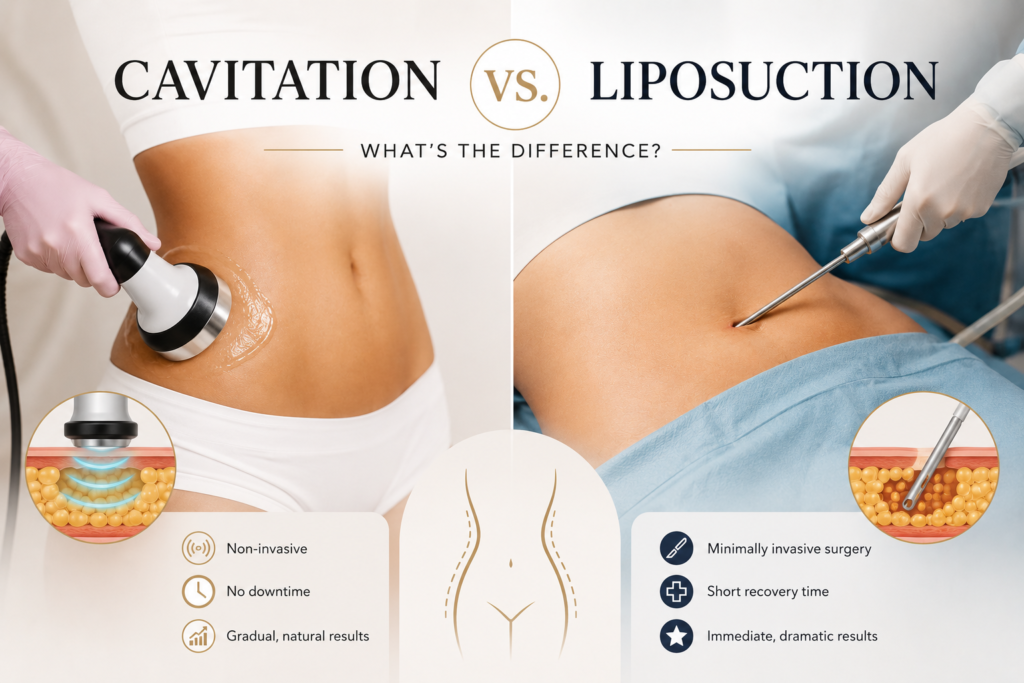
Choosing between Cavitation vs. Liposuction usually comes down to one honest question: are you looking to reshape a small area without surgery, or are you ready to remove a larger volume of fat in a single operating room visit?
Both target stubborn pockets that resist diet and exercise, yet they work through completely different mechanisms, carry different price tags, and produce results on very different timelines. Understanding where each one fits saves you money, recovery time, and disappointment.
This guide breaks down how each treatment works, what the clinical data actually shows, who qualifies for each, and how to decide which one suits your goals.
What Ultrasonic Cavitation Actually Does
Ultrasonic cavitation is a non invasive body contouring treatment that uses low frequency ultrasound waves, typically in the 30 to 40 kHz range, applied through a handpiece on the skin surface. Those waves create microscopic bubbles in the fluid surrounding fat cells. As the bubbles expand and collapse, the pressure change disrupts the membrane of the adipocyte, releasing its stored triglycerides into the interstitial fluid. The body then processes that material through the lymphatic system and the liver.
Nothing is cut. Nothing is suctioned out. No anesthesia is used, and most people describe the sensation as warm pressure with a faint buzzing sound in the ear caused by the ultrasound frequency.
A single session usually runs 30 to 60 minutes depending on how many areas are treated. Because the body needs time to clear the released lipids, sessions are spaced roughly 72 hours apart, and a full course generally runs six to twelve appointments. Most clinics, including our cavitation treatment program, pair the sessions with lymphatic drainage massage and a hydration protocol to help the body flush the byproducts efficiently.
Common treatment zones include the abdomen, flanks, outer and inner thighs, upper arms, back, and the area above the knees.
What Liposuction Actually Does
Liposuction is a surgical procedure. A surgeon makes small incisions, infiltrates the area with a tumescent solution containing saline, lidocaine, and epinephrine, then passes a thin hollow cannula through the fat layer while a vacuum device removes the tissue permanently. Variations include tumescent liposuction, power assisted liposuction, ultrasound assisted liposuction, and laser assisted liposuction, but the core principle stays the same: fat cells leave the body through a tube.
It is performed under local anesthesia with sedation or under general anesthesia, in an accredited surgical facility, by a board certified plastic surgeon. Recovery involves compression garments, swelling that can last months, and real downtime.
Because it removes fat cells rather than shrinking them, liposuction produces a permanent change in the number of adipocytes in the treated area. The remaining cells can still enlarge if you gain significant weight later, which is why surgeons stress that the procedure is a contouring tool and not a weight loss method.
Cavitation vs. Liposuction: Side by Side Comparison
| Factor | Ultrasonic Cavitation | Liposuction |
| Type of procedure | Non invasive, no incisions | Surgical, requires incisions |
| Anesthesia | None | Local with sedation or general |
| Session length | 30 to 60 minutes | 1 to 4 hours depending on areas |
| Number of visits | 6 to 12 typically | Usually one |
| Downtime | None, return to normal same day | 3 to 7 days off work, weeks of restricted activity |
| Fat volume addressed | Small, localized pockets | Up to about 5 liters in one outpatient session |
| Typical circumference change | Roughly 1 to 4 cm across a full course | Often 5 to 15 cm or more depending on volume removed |
| Permanence | Fat cells damaged, remaining cells can refill with weight gain | Removed cells do not return |
| Scarring | None | Small scars at incision sites, usually a few millimeters |
| Average cost | About $75 to $250 per session | About $4,000 surgeon fee, $6,000 to $9,000 total in many markets |
| Risk profile | Very low, mild redness or tenderness | Bruising, seroma, contour irregularity, infection, rare serious complications |
| Best candidate | Within about 15 to 20 pounds of goal weight, good skin elasticity | Localized fat deposits, stable weight, firm skin tone |
The Numbers Worth Knowing
Demand for both categories keeps climbing, but they serve different segments of the market.
| Statistic | Figure |
| Liposuction procedures performed in the United States in 2023 | Roughly 347,000, ranking it among the top surgical cosmetic procedures |
| Growth in non invasive fat reduction demand over the past decade | Non surgical procedures now account for the clear majority of all cosmetic treatments performed annually |
| Typical fat removal limit per outpatient liposuction session | About 5 liters, roughly 11 pounds, for patient safety |
| Reported patient satisfaction with liposuction results | Frequently cited above 85 percent in follow up surveys |
| Average time to see final liposuction results | 3 to 6 months once swelling fully resolves |
| Average time to see cavitation results | Gradual, with visible change usually after the third to sixth session |
| Session spacing for cavitation | Minimum 72 hours between treatments on the same area |
| Water intake commonly recommended around cavitation sessions | About 1.5 to 2 liters daily to support lymphatic clearance |
Published clinical work on ultrasonic cavitation generally reports modest but measurable circumference reduction, most often in the range of one to a few centimeters over a complete course of treatments. Studies vary in device frequency, session count, and whether diet was controlled, so results reported across the literature are not uniform.
What the data consistently shows is that cavitation produces subtle contouring rather than dramatic change, and that outcomes hold only when body weight stays stable.
Liposuction data tells a different story. Volume removed correlates directly with visible change, and the reshaping is immediate once swelling settles. The tradeoff is surgical risk, cost, and recovery.
Pain, Recovery, and Downtime Compared
| Stage | Cavitation | Liposuction |
| During treatment | Painless warmth, audible high pitched tone | Numb under anesthesia, pressure sensation if sedated only |
| First 48 hours | Possible mild redness, occasional thirst | Soreness similar to intense muscle strain, drainage from incisions |
| First two weeks | No restrictions | Compression garment worn nearly full time, walking encouraged, no heavy lifting |
| Weeks 3 to 6 | No restrictions | Gradual return to exercise, swelling still present |
| Months 3 to 6 | Maintenance sessions optional | Final contour becomes visible |
The downtime gap is the single biggest practical difference for most people. Cavitation fits into a lunch break. Liposuction requires planning time off, arranging help at home, and accepting several weeks of swelling before you know what your result looks like.
Cost Breakdown
Pricing varies by city, provider credentials, and how many areas you treat.
| Treatment | Typical Range | What It Covers |
| Single cavitation session | $75 to $250 | One area, one visit |
| Full cavitation course of 8 sessions | $600 to $1,600 | Complete protocol, often bundled with lymphatic drainage |
| Liposuction, one small area | $2,500 to $5,000 | Surgeon fee only in many quotes |
| Liposuction, multiple areas | $6,000 to $12,000 or higher | Surgeon, anesthesia, facility fee, garments, follow up |
Neither procedure is typically covered by insurance since both are considered cosmetic. Always confirm whether a surgical quote includes anesthesia and facility fees, because those line items often appear separately and can add several thousand dollars.
Who Should Consider Each One
Cavitation makes sense when you are close to your goal weight, want to refine a specific area such as the lower abdomen or flanks, cannot take time off, or simply do not want surgery. It also pairs well with other contouring approaches. Many clients combine it with customized body contouring programs or with wood therapy sessions to work on both fat reduction and skin texture at the same time.
Liposuction makes sense when you have a defined fat deposit that has not responded to years of consistent training and nutrition, when you want a single permanent correction, when the volume involved is beyond what any non surgical device can address, and when you are medically cleared for anesthesia.
Cavitation is not appropriate for everyone. Providers generally avoid treating people who are pregnant or breastfeeding, who have liver or kidney conditions, who have a pacemaker or metal implants in the treatment zone, who have active cancer, or who have open skin lesions in the area. A proper consultation screens for all of this before the first session.
Liposuction candidacy depends on cardiovascular health, BMI, skin elasticity, medication history, and smoking status. Poor skin retraction after fat removal can leave loose tissue, which is why surgeons assess elasticity carefully.
Can You Combine Them?
Yes, and plenty of people do, though not simultaneously. A common pattern is liposuction first for volume, then cavitation and lymphatic work later as maintenance once the surgeon clears you, usually several months out. Another pattern runs the other direction: someone tries a cavitation course, sees the subtle improvement, and decides the area needs more correction than a non invasive device can deliver.
If you want to see what realistic outcomes look like before committing, browsing a provider’s before and after gallery tells you more than any brochure claim. Look specifically for photos taken in the same lighting, same pose, and same distance.
Questions to Ask Before You Book Either One
Ask how many sessions the provider expects for your specific area and what happens if results fall short. Ask what device is being used and at what frequency. Ask for the total cost including all fees. For surgery, ask about board certification, facility accreditation, and complication rates. For cavitation, ask whether lymphatic drainage is included and what the aftercare protocol looks like.
Be skeptical of any promise that a non surgical device will replicate surgical results. The physics do not allow it. A good provider will tell you plainly when your goal is better served by a different treatment, and that honesty is worth more than an aggressive sales pitch.
The Bottom Line
The comparison of Cavitation vs. Liposuction is really a comparison between refinement and removal. Cavitation shrinks and smooths localized pockets gradually with zero downtime and modest cost, making it a strong fit for people near their goal weight who want steady, subtle improvement. Liposuction removes fat permanently in one procedure, delivering dramatic reshaping at the cost of surgery, recovery, and a much larger investment.
Neither one is a substitute for weight loss, and neither one holds up without stable habits afterward. Choose based on the amount of fat involved, your tolerance for downtime, and your budget.
If you are still unsure which direction fits your body and your schedule, a consultation is the fastest way to get a straight answer. You can review the full range of treatments available at World of Beauty Miami or reach out to the team to have your goals assessed in person before you spend anything.