
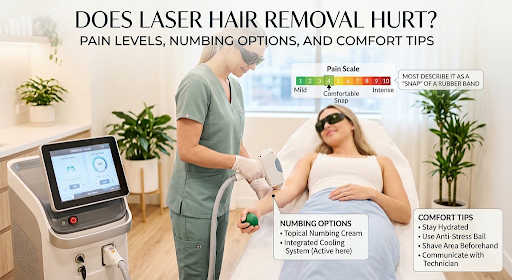
Does laser hair removal hurt? For most people, it feels less like a sharp pain and more like a quick rubber band snap against the skin combined with a warm sensation. Discomfort varies by body area, hair thickness, skin type, laser technology, cooling, and personal pain tolerance.
Laser hair removal targets the pigment in the hair follicle. The laser energy heats the follicle while the surrounding skin should stay as cool as possible, which is why cooling systems and proper technique make a major difference in comfort.
Many clients describe the sensation as tolerable, especially on smaller areas such as the underarms or upper lip. Larger or denser areas, including the back, chest, bikini line, and legs, can feel more intense because more pulses are required and the skin may hold more heat.
What Laser Hair Removal Feels Like
The most common comparison is a rubber band snapping against the skin. Some people also feel a brief sting, heat flash, or prickling sensation with each pulse.
The feeling lasts only for a fraction of a second per pulse. However, a full treatment involves many pulses, so sensitivity can build up in dense or bony areas.
Pain is usually strongest during the treatment and settles shortly afterward. Mild redness, warmth, and swelling around the follicles are common and often resolve within hours.
Common Sensations
| Sensation | What it feels like | How long it usually lasts |
| Rubber band snap | Quick, sharp flick against the skin | A fraction of a second per pulse |
| Warmth | Heat spreading across the treated area | During treatment and shortly afterward |
| Stinging | Brief pin like discomfort, often in dense hair areas | Seconds at a time |
| Follicle swelling | Small raised bumps around hair follicles | Usually a few hours |
| Tenderness | Mild soreness, similar to light sunburn | Often resolves within 24 hours |
Pain Levels by Treatment Area
Not every body area feels the same. Areas with thicker hair, dense follicles, thin skin, or close proximity to bone often feel more sensitive.
| Treatment area | Typical discomfort level | Why it may feel different |
| Underarms | Moderate | Dense hair and thin, sensitive skin |
| Bikini line | Moderate to high | Thick hair, sensitive skin, and curved contours |
| Brazilian area | Moderate to high | Dense follicles and highly sensitive tissue |
| Upper lip | Moderate | Small area but very responsive skin |
| Chin and jawline | Mild to moderate | Often sensitive due to thicker terminal hairs |
| Legs | Mild to moderate | Larger area, but usually less sensitive skin |
| Arms | Mild | Finer hair and less dense follicles in many people |
| Back | Mild to moderate | Large surface area and variable hair density |
| Chest or abdomen | Mild to moderate | Hair density and skin sensitivity vary widely |
A study of diode laser treatment on the trunk in men reported a mean pain score of 4.1 on a scale from 0 to 9, where 9 was very painful and unbearable. This shows that discomfort can be real, but it also shows that many patients find treatment manageable.
Factors That Affect Pain
Pain during laser hair removal is not only about the laser. Your skin, hair, hormones, treatment settings, and preparation all influence how the session feels.
Main Factors
| Factor | Effect on comfort |
| Hair thickness and density | Thicker, darker, or denser hair can create more heat and stronger sensations |
| Treatment area | Sensitive zones such as the bikini line and underarms may feel more intense |
| Skin tone | Darker skin may require careful laser selection and settings to protect the epidermis |
| Laser type | Alexandrite, diode, and Nd:YAG lasers feel different because of wavelength, spot size, and cooling method |
| Cooling system | Contact cooling, cold air, or cryogen spray can reduce surface heat and discomfort |
| Fluence and pulse duration | Higher energy may improve results but can increase sensation if not balanced correctly |
| Recent sun exposure | Tanned or irritated skin can be more reactive and may require treatment delay |
| Stress and fatigue | Lower pain tolerance can make the same session feel more uncomfortable |
| Menstrual cycle | Some people report greater sensitivity during certain phases of their cycle |
Cooling is especially important. Research on alexandrite laser treatment found that longer cooling spurts reduced pain, and cooling devices are used to lower the risk of epidermal injury as well as improve comfort.
Numbing Options Before Treatment
You do not need to accept unnecessary discomfort. Several comfort options can be used before or during treatment, depending on the area, your medical history, and the clinic protocol.
Common Comfort Options
| Option | How it helps | Important note |
| Built in contact cooling | Cools the skin during each pulse | Common in modern diode and alexandrite systems |
| Cold air cooling | Blows chilled air onto the skin before, during, or after pulses | Useful for larger areas and sensitive skin |
| Cryogen spray | Provides a brief cooling burst with the laser pulse | Must be used carefully by trained providers |
| Topical numbing cream | Numbs the surface of the skin before treatment | Should be approved by the treating provider |
| Ice packs after treatment | Reduces immediate heat and inflammation | Useful for short term post treatment comfort |
| Lower fluence starting settings | Reduces heat and discomfort while maintaining safety | May require more sessions for some patients |
| Pulsing technique | Allows brief pauses between treatment sections | Helps prevent heat buildup in sensitive areas |
Topical numbing creams can reduce discomfort, but they do not remove all sensation. A study comparing 5 percent lidocaine cream found that it reduced pain during alexandrite and diode laser hair removal, although it did not eliminate it completely.
Do not apply a numbing cream without guidance from the clinic. Large areas, broken skin, or excessive use of lidocaine products can create safety concerns. Your provider should confirm the product, amount, application time, and body area.
What Research Says About Discomfort
Clinical studies give useful context for what patients can expect. Pain scores vary because researchers use different scales, lasers, body areas, and cooling methods.
| Study finding | Reported result | What it suggests |
| Diode laser treatment on the trunk | Mean pain score of 4.1 out of 9 | Treatment is noticeable but often tolerable |
| Alexandrite laser with sapphire cooling | Average pain score of 4.6 out of 40 | Cooling can keep discomfort low |
| Pneumatic skin flattening versus dynamic cooling | 2.8 out of 10 versus 5.4 out of 10 | Technique and skin stabilization can reduce pain substantially |
| Brushing technique versus stamping technique | 2.2 out of 10 versus 2.7 out of 10 | Movement method can affect comfort |
| Home use laser study | 66.7 percent of participants reported pain | Professional cooling and settings may improve comfort |
These figures do not promise that every session will feel the same. They show that pain is common but can often be reduced through cooling, proper settings, and an experienced provider.
How to Make Treatment More Comfortable
Preparation and aftercare can make a noticeable difference. The goal is to arrive with calm, unirritated skin and leave with minimal heat in the treated area.
Before Your Session
- Shave the treatment area 24 to 48 hours before your appointment, unless your provider gives different instructions.
- Avoid waxing, plucking, threading, or epilating before treatment because the laser needs the hair root to target the follicle.
- Stay out of direct sun and avoid self tanning products before your session.
- Tell your provider about medications, recent skincare treatments, and any history of cold sores or skin sensitivity.
- Wear loose clothing to reduce friction after treatment.
- Avoid applying lotion, makeup, deodorant, or perfume to the treatment area on the day of your appointment.
- Ask whether a topical numbing option is appropriate for your skin and treatment area.
During Your Session
- Communicate openly if the sensation becomes too intense.
- Ask for short breaks during larger treatments if needed.
- Make sure the provider uses appropriate cooling throughout the session.
- Keep the skin flat and stable so the laser can work evenly.
- Do not request higher energy simply to finish faster; comfort and safety should guide the settings.
After Your Session
- Use cool compresses if the skin feels warm or tender.
- Apply a gentle, fragrance free moisturizer if your provider recommends it.
- Avoid hot showers, saunas, intense workouts, and excessive heat for the first day or as directed.
- Use broad spectrum sunscreen on exposed treated areas.
- Do not exfoliate, wax, or use strong active skincare products until irritation settles.
- Avoid picking at treated follicles or any small crusts.
Laser Hair Removal Compared With Waxing
Many people choose laser hair removal because they want to reduce the repeated discomfort of waxing. A laser session may feel sharp and warm, but it does not pull hair from the root the way waxing does.
| Factor | Laser hair removal | Waxing |
| Sensation | Quick heat pulses and rubber band snaps | Pulling hair from the root |
| Duration of discomfort | Brief pulses during treatment | Short but often intense during removal |
| Frequency | Multiple sessions spaced several weeks apart | Usually every 3 to 6 weeks |
| Long term hair reduction | Can reduce hair growth over a treatment course | Hair regrows from the follicle |
| Skin reaction | Temporary redness and follicle swelling | Redness, bumps, and possible ingrown hairs |
| Best suited for | People seeking long term reduction | People who want immediate smoothness |
If you are deciding between the two methods, this guide to laser hair removal versus waxing explains the differences in comfort, cost, and long term results.
Is It More Painful for Darker Skin Tones?
Darker skin contains more melanin, which can absorb laser energy. That does not mean laser hair removal is unsafe, but it does mean the correct wavelength, cooling, and energy settings are essential.
Nd:YAG lasers, commonly operating at 1064 nm, are often selected for deeper skin tones because they penetrate more deeply and carry less risk of affecting the surface pigment when used appropriately. Contact cooling devices have also been studied for safety and tolerability across a wide range of skin phototypes.
The Mayo Clinic notes that skin color changes can occur after laser hair removal and that the risk may be higher in people with black or brown skin, particularly when sun exposure is not avoided before or after treatment.
A qualified provider should perform a patch test or conservative first session when needed. Never choose a clinic based only on price; experience with your specific skin type matters.
When Discomfort Is Not Normal
Mild warmth, redness, and small bumps around follicles are common after treatment. However, severe pain, blistering, prolonged swelling, crusting, or significant color change should be reported to your provider.
The Mayo Clinic lists skin irritation, temporary pigment changes, blistering, crusting, scarring, and texture changes as possible risks, although serious effects are uncommon when treatment is performed correctly.
Contact the clinic promptly if you notice:
- Blistering or broken skin
- Intense pain that worsens rather than improves
- Dark or light patches that do not fade
- Signs of infection such as increasing warmth, pus, or fever
- Unusual swelling that lasts beyond the expected recovery period
Who Should Wait Before Treatment
Laser hair removal is not suitable for everyone at every moment. Your provider may postpone treatment if you have a sunburn, active skin infection, open wounds, recent waxing, or certain photosensitizing medications.
People who are pregnant are often advised to wait until after pregnancy, not because laser hair removal has been proven harmful, but because there is limited research on laser treatment during pregnancy. Always follow the advice of your medical provider.
If you have a history of cold sores, tell your provider before treatment near the mouth. Preventive medication may be recommended in some cases.
Choosing a Comfortable Clinic
The clinic experience matters. A skilled provider will assess your skin and hair, explain the expected sensation, adjust settings safely, and use cooling throughout the procedure.
When comparing clinics, ask:
- Which laser wavelengths and cooling systems do you use?
- How do you adjust treatment for my skin tone and hair color?
- Do you offer topical numbing for sensitive areas?
- How do you prevent burns and pigment changes?
- What is your protocol if I feel too much discomfort?
- How many sessions will I likely need?
A reputable clinic will welcome these questions. You can explore the clinic’s laser hair removal service to understand the treatment approach and available options.
Final Thoughts
Laser hair removal can hurt, but for most people the discomfort is brief, manageable, and reduced with modern cooling and skilled technique. The sensation is often compared to a rubber band snap, with warmth or stinging that fades soon after each pulse.
The most comfortable results come from proper preparation, appropriate laser selection, effective cooling, and realistic expectations. Numbing creams, cold air, contact cooling, and careful treatment pacing can all help.
If you are sensitive to pain, start with a smaller area or request a patch test. Speak openly with your provider, follow the preparation and aftercare instructions, and choose a clinic that prioritizes both safety and comfort.