
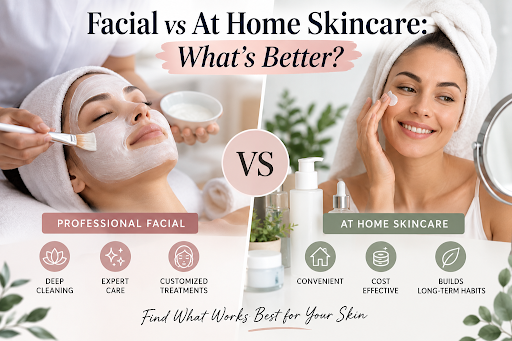
Facial vs At Home Skincare: What’s Better? The answer depends on what your skin needs and what you expect from your routine. At home skincare is the foundation of healthy skin because cleansing, moisturizing, sun protection, and suitable active ingredients work through consistent daily use.
Professional facials can complement that routine by providing deeper cleansing, controlled exfoliation, extractions when appropriate, hydration, and treatment selected according to current skin concerns.
For most people, the best approach is not choosing one over the other. Regular home care helps protect and maintain the skin every day, while professional treatments can provide targeted support when congestion, dryness, dullness, uneven texture, or other cosmetic concerns need additional attention.
What Is At Home Skincare?
At home skincare refers to the products and habits you use regularly without visiting a professional. A basic routine may include a cleanser, moisturizer, sunscreen, and selected ingredients for concerns such as acne, pigmentation, dryness, or visible signs of aging.
The American Academy of Dermatology recommends daily sun protection as an important part of healthy skin care. It advises choosing a broad spectrum, water resistant sunscreen with SPF 30 or higher.
At home care is especially valuable because skin is exposed to sunlight, pollution, sweat, cosmetics, and environmental conditions every day. Consistency allows supportive products to work over weeks and months rather than only during occasional appointments.
What Is a Professional Facial?
A professional facial is a cosmetic skin treatment performed by a trained professional. The exact steps vary depending on the treatment and the client’s skin.
A facial may involve cleansing, exfoliation, hydration, masks, massage, steam, or carefully performed extractions. Some services may also include technology such as LED treatment depending on the provider and selected facial.
At World of Beauty Miami, facial care can be selected according to concerns such as dryness, congestion, sensitivity, dullness, and visible signs of aging.
A professional facial should not be confused with medical treatment for conditions such as severe acne, suspicious skin lesions, infections, or persistent inflammatory skin disorders. These concerns may require evaluation by a dermatologist or another qualified healthcare professional.
Facial vs At Home Skincare at a Glance
| Feature | At Home Skincare | Professional Facial |
| Frequency | Usually daily | Periodic based on skin needs |
| Main purpose | Maintenance, protection, hydration, and targeted daily care | Targeted cosmetic treatment and professional skin assessment |
| Cleansing | Regular surface cleansing | May include more detailed cleansing and extractions |
| Exfoliation | Usually lower strength products | May include professionally selected exfoliation |
| Customization | Based on products selected by the user | Can be adjusted during professional assessment |
| Sun protection | Essential part of daily care | Does not replace daily sunscreen |
| Convenience | Performed at home | Requires an appointment |
| Long term role | Forms the foundation of routine skin maintenance | Complements consistent home care |
Why At Home Skincare Matters So Much
The strongest advantage of home skincare is consistency. Even an excellent professional facial cannot replace the benefits of protecting and caring for the skin between appointments.
Daily sunscreen is a clear example. SPF describes protection against ultraviolet B radiation, which contributes to sunburn. According to the American Academy of Dermatology, SPF 15 filters approximately 93 percent of UVB radiation, while SPF 30 filters approximately 97 percent.
This does not mean SPF 30 makes someone completely protected from the sun. No sunscreen filters 100 percent of UVB radiation, and sun protection also involves shade, protective clothing, correct application, and reapplication when appropriate.
Daily Sunscreen Has Measurable Long Term Benefits
One of the strongest reasons home skincare cannot be replaced by occasional facials is the evidence supporting regular photoprotection.
A randomized controlled trial involving 903 adults compared daily sunscreen use with discretionary sunscreen use. After 4.5 years, the daily sunscreen group showed 24 percent less skin aging than the group using sunscreen at their discretion.
Another study followed 32 people using a broad spectrum SPF 30 facial sunscreen every day for 52 weeks. Clinical assessments found significant improvements in photoaging parameters, with skin texture, clarity, and pigmentation measures improving by approximately 40 to 52 percent from baseline by the end of the study.
These findings demonstrate why an effective skincare routine must continue every day, regardless of how often someone receives professional treatments.
Evidence Supporting Consistent Home Care
| Research finding | Result |
| Randomized sunscreen trial | 903 adults participated |
| Daily sunscreen follow up | 4.5 years |
| Reduction in measured skin aging | 24% less aging with daily sunscreen compared with discretionary use |
| SPF 30 UVB filtration | Approximately 97% when properly applied |
| One year facial sunscreen study | 32 participants |
| Improvement in selected photoaging measures | Approximately 40% to 52% from baseline |
Sources include the American Academy of Dermatology and peer reviewed clinical studies indexed by PubMed.
What Professional Facials Can Add
Home care provides routine maintenance, but professional treatments can address needs that may be difficult to manage effectively on your own.
A trained professional can examine the visible condition of the skin before selecting products and treatment steps. Someone with dehydration may need a very different facial from someone dealing with congestion or excess oil.
Professional treatments can also involve procedures that should not be attempted aggressively at home. Examples include extractions and stronger forms of exfoliation.
Those interested in targeted treatment can explore a professional facial service in Miami to understand how facials can be adapted for concerns such as dryness, congestion, sensitivity, dullness, and texture.
Professional Extractions Versus Squeezing at Home
Blackheads and whiteheads are common reasons people try to perform extractions themselves. Improper squeezing, excessive pressure, or repeated manipulation can irritate the skin.
The American Academy of Dermatology notes that professional comedone extraction can be considered for stubborn blackheads and whiteheads when appropriate.
This does not mean every facial needs extractions. Whether they are appropriate depends on the type of congestion, skin sensitivity, current treatments, and overall skin condition.
Professional technique matters because unnecessary trauma may increase irritation and visible redness.
Exfoliation Is Another Important Difference
Exfoliation helps remove cells from the outer surface of the skin. Many home products contain ingredients such as salicylic acid, glycolic acid, lactic acid, or retinoids.
However, strength and concentration matter. Products designed for professional procedures should not automatically be treated as stronger versions of ordinary home skincare.
In 2024, the United States Food and Drug Administration warned consumers against purchasing or using certain high concentration chemical peel products without professional supervision. The agency noted risks including chemical burns, pain, swelling, infection, changes in skin color, and scarring.
This illustrates an important principle. More aggressive treatment is not automatically better treatment.
Can Home Skincare Improve Fine Lines and Texture?
Yes, certain ingredients have evidence supporting improvements in visible signs of photoaging.
Retinoids are among the best studied topical options. The American Academy of Dermatology explains that retinoids can improve skin tone and reduce the appearance of fine lines and wrinkles by influencing cell turnover and collagen.
A randomized clinical study of a moisturizer containing 0.1 percent stabilized retinol included 36 participants using the retinol product and 28 using the vehicle comparison. After eight weeks, the retinol moisturizer produced significantly greater improvement in lines, wrinkles, pigmentation, elasticity, firmness, and overall photodamage.
Retinoids can cause irritation in some people, so product selection and frequency should be appropriate for the individual’s skin.
Can a Facial Replace Retinol or Sunscreen?
No.
A professional facial and a daily topical routine perform different roles. A facial cannot provide continuous ultraviolet protection after you leave the treatment room.
Similarly, a single exfoliating or hydrating treatment does not reproduce the cumulative effects of properly selected products used consistently over time.
Professional facials work best when they support a sensible routine rather than replace it.
When Professional Facials May Be Especially Helpful
People often consider facials when they experience persistent dullness, dryness, rough texture, superficial congestion, or when they want a professional assessment of their current routine.
Facials can also be useful before beginning a more structured skincare plan because a professional may identify visible factors that influence product choices.
For more information about frequency, the guide on how often you should get a facial explains why treatment schedules should depend on individual goals and skin condition rather than a universal calendar.
How Often Should You Get a Facial?
There is no scientifically established schedule that is ideal for everyone.
Some facial providers commonly recommend appointments every four to six weeks, but the appropriate interval can vary according to skin type, treatment intensity, goals, tolerance, and home routine.
World of Beauty Miami notes that many clients may benefit from facial treatment every four to six weeks, while concerns such as acne, clogged pores, dryness, or uneven texture may require a more personalized schedule.
People using prescription acne treatments, retinoids, or other potentially irritating products should tell their provider before receiving exfoliation or other facial procedures.
How Often Should At Home Skincare Be Used?
Unlike facials, basic home care is usually performed daily.
Cleansing frequency should still be sensible. Excessive washing and harsh scrubbing can irritate the skin rather than improve it.
The American Academy of Dermatology recommends gentle cleansing for acne prone skin and notes that people using isotretinoin should generally limit cleansing to twice daily and after sweating.
Moisturizer can also play an important role, even for acne prone skin. Dermatologists note that acne medications such as benzoyl peroxide, salicylic acid, adapalene, tretinoin, and others can cause dryness and irritation, making suitable moisturization useful.
Facial or At Home Skincare for Acne?
For mild congestion, a gentle home routine may help maintain clearer pores. Depending on the individual, suitable ingredients may include salicylic acid, benzoyl peroxide, or certain retinoids.
Professional extraction can sometimes help with stubborn comedones, but a cosmetic facial is not a replacement for medical acne treatment.
Moderate, severe, painful, scarring, or persistent acne should be assessed by a dermatologist. Hormonal acne and acne that does not respond to appropriate nonprescription treatment may also require medical evaluation.
Facial or Home Care for Dry Skin?
Daily home care is essential for dryness because moisture needs to be maintained continuously.
A suitable moisturizer helps reduce water loss and support the skin barrier. Ingredients commonly used for hydration include glycerin, hyaluronic acid, ceramides, and other humectants and emollients. The AAD specifically identifies several of these ingredients as useful for supporting dry skin.
A professional hydrating facial may provide additional temporary comfort and cosmetic improvement, but it should be followed by an appropriate home routine.
Facial or Home Care for Dull Skin?
Dullness can have several causes, including surface cell buildup, dryness, photodamage, and uneven pigmentation.
Gentle cleansing, moisturizing, appropriate exfoliation, and regular sunscreen can help maintain a brighter appearance over time.
Professional facials may provide more immediate surface refinement through exfoliation and hydration. People wanting to understand the broader role of these treatments can read about the benefits of regular facials.
Facial or Home Care for Uneven Pigmentation?
Daily sunscreen is fundamental when pigmentation is a concern because ultraviolet exposure can worsen many forms of discoloration.
The AAD recommends broad spectrum SPF 30 or higher. It also notes that tinted sunscreens containing iron oxide can provide additional protection against visible light, which can be relevant for people prone to dark spots.
Persistent melasma or other pigmentation disorders may need professional medical evaluation because the correct treatment depends on the cause.
Where People Commonly Go Wrong With Home Skincare
The biggest problem with home routines is often not a lack of products. It is using too many products, applying them incorrectly, or combining ingredients that cause unnecessary irritation.
The American Academy of Dermatology advises focusing on one main aging concern rather than introducing numerous products at once. Using several new products over a short period can irritate the skin.
A simple routine that is suitable for your skin and used consistently can be more useful than a complicated routine that changes every week.
Where People Commonly Go Wrong With Facials
The main mistake is expecting a facial to correct every skin concern.
Facials can improve the appearance and feel of the skin, but they cannot replace sun protection, treat every form of acne, permanently remove pigmentation, or stop the normal aging process.
Another mistake is receiving procedures that are too aggressive for the current condition of the skin. Strong exfoliation may be inappropriate when the skin barrier is irritated or when someone is using certain topical or oral medications.
A good treatment plan considers what the skin can tolerate, not simply what procedure sounds strongest.
Facial vs At Home Skincare by Goal
| Skin goal | At Home Skincare | Professional Facial | Best general approach |
| Daily sun protection | Essential | Cannot replace it | Daily home care |
| Basic hydration | Essential | Can provide additional hydration | Combine both when needed |
| Mild congestion | Helpful with suitable products | Extractions may help selected cases | Individualized combination |
| Dull appearance | Consistent care can improve it gradually | Can provide more immediate surface refresh | Combine both |
| Fine lines | Sunscreen and selected actives may help | Certain facial treatments can complement care | Long term home care plus suitable procedures |
| Severe acne | May support medical treatment | Cosmetic facial alone is insufficient | Dermatology assessment |
| Strong exfoliation | High strength treatment may be unsafe at home | Professional supervision is safer for appropriate procedures | Professional evaluation |
So, Which Is Better?
For long term skin health and maintenance, at home skincare is more important because it happens every day.
A professional facial cannot compensate for repeatedly skipping sunscreen, using unsuitable products, or neglecting basic cleansing and moisturizing.
At the same time, home care has limits. Professional facials can offer individualized treatment, controlled exfoliation, careful extractions, and additional hydration that may be difficult to reproduce safely at home.
This means the most useful comparison is not facial versus skincare. It is how both can work together.
A Practical Routine That Combines Both
For many people, a reasonable home routine starts with gentle cleansing, moisturizer suited to the skin type, and broad spectrum SPF 30 or higher during the day.
Additional products should be chosen according to specific concerns rather than added simply because they are popular.
Professional facials can then be scheduled according to skin condition, goals, budget, and tolerance. Some people may enjoy regular appointments, while others may need them only occasionally.
If persistent acne, dermatitis, rosacea, unusual pigmentation, changing moles, infection, or another medical concern is present, medical evaluation should take priority over cosmetic treatment.
Final Thoughts
When comparing Facial vs At Home Skincare: What’s Better?, the strongest answer is that daily skincare provides the foundation, while professional facials can provide targeted support.
Research strongly supports consistent behaviors such as daily sun protection. In a randomized trial involving 903 adults, daily sunscreen users experienced 24 percent less measured skin aging over 4.5 years than discretionary users. SPF 30 also filters approximately 97 percent of UVB radiation when used correctly.
Professional treatments have a different purpose. They can help with cleansing, hydration, cosmetic exfoliation, selected extractions, and personalized treatment planning, but they do not replace the products and protective habits used between appointments.
The most effective strategy is therefore consistent, appropriate home care combined with professional treatment when your skin actually needs it. This approach addresses both daily maintenance and targeted concerns without expecting one method to perform the role of the other.