
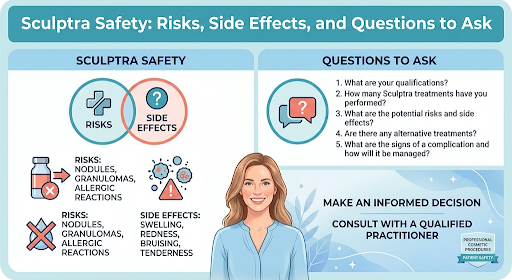
Before considering an elective injectable, adults should understand Sculptra Safety: Risks, Side Effects, and Questions to Ask. FDA approval supports specific uses, but it does not mean treatment is appropriate for everyone or every body area. Medical history, the practitioner’s experience, and a clear plan for complications all deserve attention. U.S. Food and Drug Administration
For readers exploring the services listed by World of Beauty Miami, this guide explains how to distinguish expected reactions from warning signs and what to discuss before giving consent.
What Is Sculptra, and Is It FDA Approved?
Sculptra is an injectable implant containing poly L lactic acid, commonly abbreviated PLLA. This biodegradable synthetic material helps stimulate collagen production. Its effects develop gradually, so the appearance immediately after an appointment does not represent the final result.
Approved cosmetic facial uses include certain nasolabial folds, other facial wrinkles, and fine lines and wrinkles in the cheeks. Nasolabial folds are the lines extending between the nose and the corners of the mouth. The FDA approved the expanded cheek indication on April 25, 2023, for people capable of producing a normal immune response.
The Sculptra treatment overview provides context for the service, but a medical consultation should identify the exact proposed treatment area. Approval of a product is not approval for unrestricted use throughout the body. The FDA has not approved injectable fillers for body contouring or enhancement.
What Are the Common Sculptra Side Effects?
Reported reactions include swelling, tenderness, bruising, redness, pain, itching, bleeding, and lumps around injection sites. Their intensity and duration vary.
The FDA’s cheek wrinkle study enrolled 149 participants, including 97 assigned to Sculptra treatment. Diary information was available from 93 treated participants. Patients recorded expected reactions for 28 days after each treatment. The following figures come from that diary summary.
| Reaction recorded in patient diaries | Participants reporting it | Percentage of 93 diary respondents |
| Tenderness | 87 | 93.50% |
| Bruising | 87 | 93.50% |
| Swelling | 81 | 87.10% |
| Pain, including burning | 78 | 83.90% |
| Redness | 59 | 63.40% |
| Itching | 25 | 26.90% |
These figures include expected reactions of varying intensity, including mild symptoms. They are not rates of permanent injury or serious complications. They describe one study population rather than an individual patient’s personal risk.
The American Academy of Dermatology notes that minor reactions after filler injections often settle within 7 to 14 days, sometimes sooner. This is a general estimate, not a guarantee. Severe or unusual symptoms need assessment even when they occur within that recovery window.
Can Sculptra Cause Delayed Lumps or Nodules?
Yes. Sculptra labeling describes papules and nodules beneath the skin that may appear days to months after injection. Some can be felt without being visible or painful, and resolution can take a prolonged period.
A persistent lump should not automatically be dismissed as routine swelling. The clinician needs to assess its cause before discussing management. The patient guide explains that some lumps resolve independently or with medication, while certain cases may require surgery.
Tell the clinician when the lump appeared, whether it is changing, and whether other symptoms are present. Photographs and treatment dates can help organize that conversation, but they do not replace an examination.
Can Sculptra Be Easily Removed?
Do not assume that every filler has a simple reversal option. Sculptra contains PLLA rather than hyaluronic acid. The FDA warns that removing certain filler materials can be difficult or impossible, particularly materials other than hyaluronic acid. Additional procedures also carry risks.
When reviewing dermal filler information, ask about the exact material being proposed and how complications would be managed. A promise that any unwanted result can simply be undone deserves careful questioning.
Which Complications Require Urgent Medical Attention?
The most concerning complication is accidental injection into a blood vessel. This can obstruct blood supply and cause tissue damage, vision impairment, blindness, or stroke. Such events are uncommon, but their consequences can be permanent.
Unusual pain, sudden vision changes, or a white appearance of the skin during or shortly after treatment require immediate medical attention. Sudden difficulty speaking, facial drooping, weakness, or confusion are also emergency warning signs. Do not wait for a routine appointment or a reply to an online message.
Call 911 for sudden vision loss or suspected stroke symptoms. The treating clinic should also be informed, but contacting the clinic must not delay emergency care.
Other possible complications include infection and allergic reactions. The FDA identifies severe allergic reactions as emergencies requiring immediate medical assistance.
Who Should Avoid Sculptra or Postpone Treatment?
People With Certain Allergies or Scarring Histories
Sculptra should not be used in people allergic to its ingredients, those with severe allergies involving a history of anaphylaxis, or those with multiple severe allergies. A history of, or susceptibility to, keloids or hypertrophic scarring is also a contraindication. These are forms of raised scar tissue.
When lidocaine is included, an allergy to lidocaine or other local anesthetics of the amide type is another contraindication.
Pregnancy, Breastfeeding, and Younger Patients
Safety and effectiveness have not been evaluated during pregnancy or breastfeeding, or in patients under 18. Lack of research is not evidence that treatment is safe in these groups. Age alone also cannot establish whether treatment is appropriate; medical suitability requires an individual assessment.
Active Skin Problems and Relevant Medical Conditions
Treatment should be postponed when the planned injection area has active infection or inflammation, including certain rashes, pimples, cysts, or hives. Healing should be complete before the procedure is reconsidered.
People taking medicines that suppress the immune system need specific medical review because infection risk may increase. Blood thinning medicines, including aspirin and warfarin, can increase bleeding or bruising associated with injections. Do not stop a prescribed medicine on your own to prepare for an elective procedure.
A consultation should address the entire medical history rather than rely on a brief allergy question.
What Should You Ask the Practitioner?
The FDA recommends a licensed healthcare professional with relevant filler experience, knowledge of anatomy, and the ability to manage complications. The individual performing the procedure matters more than a general description of a clinic as experienced.
Use the consultation to request specific answers rather than broad reassurance.
| Question to ask | What the answer should clarify |
| Who will perform the injections, and what is their professional license? | The identity and qualifications of the treating clinician |
| What training and experience do you have with Sculptra? | Experience with this particular product, not only injectables generally |
| Is the proposed use FDA approved? | The exact treatment area and any use outside the approved indications |
| Which parts of my medical history change the risk? | Relevant allergies, scarring, conditions, medicines, and previous procedures |
| How would you manage a persistent lump or a vascular emergency? | An established assessment, treatment, and referral plan |
| How will recovery be reviewed, and whom should I contact after hours? | Clear arrangements for medical advice and follow up |
| What alternatives are reasonable, including no treatment? | Whether proceeding is appropriate rather than simply available |
| What does the full quoted cost cover? | Treatment, planned reviews, and the policy for additional care |
These questions build on FDA guidance and the American Academy of Dermatology’s recommendations for filler consultations.
Bring an accurate list of prescriptions, nonprescription medicines, vitamins, and supplements. Also disclose previous fillers, implants, cosmetic procedures, and cold sore outbreaks. The AAD specifically recommends sharing this information rather than deciding independently that something is irrelevant.
A useful consultation should leave enough time to consider the answers. You should not need to make an immediate decision merely because a treatment appointment is available.
What Does Sculptra Aftercare Involve?
Aftercare should follow the treating clinician’s written instructions. Manufacturer guidance includes using a wrapped cold pack for common swelling, avoiding excessive sunlight and ultraviolet exposure while initial redness and swelling persist, and performing massage as directed by the clinician.
Do not substitute an online routine for personalized advice. Before leaving, ask how the instructions apply to exercise, makeup, skin care, and any planned procedures. Also ask which symptoms should trigger an ordinary phone call and which require immediate assessment.
Tell the practitioner about planned laser treatments, chemical peels, or other procedures that cause a skin response. Sculptra labeling warns of possible inflammatory reactions when these treatments are combined or performed before the skin has healed completely.
Keep a record of the product, treatment dates, and treating clinician. That information provides a useful starting point should a different healthcare professional need to assess a later concern.
How Should Results and Repeat Treatments Be Discussed?
Sculptra works gradually. The manufacturer describes an average of two to three treatment sessions over several months, although individual plans differ. Clinical study results were observed as early as one month and could persist for up to two years. These are reported study outcomes, not guarantees for every patient.
The safety conversation should therefore include how progress will be assessed before further treatment is proposed. Ask what findings would justify waiting, changing the plan, or stopping.
Initial swelling can temporarily alter appearance, and the manufacturer cautions that visible improvement develops progressively. Do not judge the completed outcome from the first day or assume that more product is automatically appropriate when swelling subsides.
A treatment plan should have a medical explanation, not simply a fixed package of appointments.
Making an Informed Decision About Sculptra Safety
An informed decision requires more than knowing that Sculptra has FDA approved uses. It means understanding expected reactions, the possibility of delayed complications, the limits of reversal, and the arrangements for urgent care.
Before consenting, make sure your questions about qualifications, medical screening, and recovery have been answered. For questions about these arrangements at the practice, contact the team with your safety questions. Request written information that you can review without pressure.
Choosing to postpone treatment or decline it altogether is a valid outcome of a consultation.