
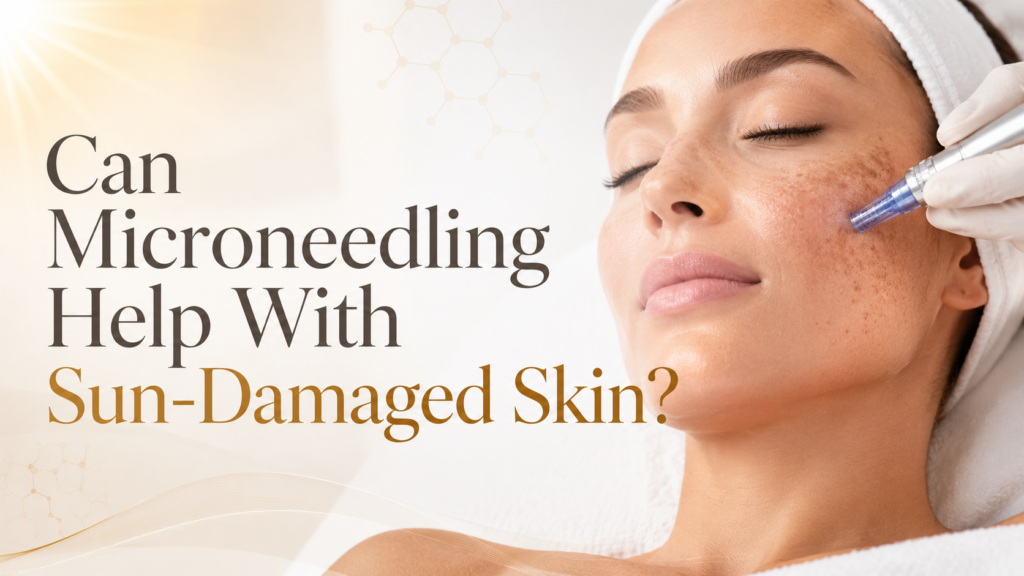
Years of ultraviolet exposure can gradually change the way skin looks and feels. Fine lines may become more noticeable, pigmentation can become uneven, and the skin may lose some of its smoothness and firmness. Can Microneedling Help With Sun-Damaged Skin?
For the right person, it can improve several visible signs associated with photoaging, particularly fine lines, uneven texture, wrinkles, and certain pigment concerns. However, microneedling cannot undo every form of ultraviolet damage, and it does not replace daily sun protection or medical evaluation of suspicious skin lesions.
Understanding what microneedling can realistically improve is the best way to decide whether it belongs in your skin care plan.
What Is Sun Damage to the Skin?
Sun damage develops mainly from repeated exposure to ultraviolet radiation. Dermatologists often use the term photoaging to describe premature skin aging caused by ultraviolet exposure.
This process is different from natural aging alone. Ultraviolet radiation can affect collagen, elastin, pigmentation, and other structures that help maintain healthy looking skin.
Common visible signs include:
| Sign of photoaging | What you may notice |
| Fine lines | Small lines around the eyes, mouth, forehead, and cheeks |
| Wrinkles | Deeper lines that become more visible with age |
| Uneven pigmentation | Brown spots, patches, or irregular skin tone |
| Rough texture | Skin that feels less smooth |
| Enlarged looking pores | Pores may appear more noticeable as skin structure changes |
| Reduced firmness | Skin may appear looser or less resilient |
| Dry or dull appearance | Skin may look less radiant and feel less hydrated |
Sun exposure is also a major risk factor for skin cancer. This distinction matters because cosmetic treatments can improve appearance, but they do not remove the health risks associated with accumulated ultraviolet exposure.
Any new, changing, bleeding, crusting, or unusual skin lesion should be evaluated by a qualified medical professional rather than treated as a cosmetic concern.
How Does Microneedling Work?
Microneedling uses very fine needles to create controlled microscopic punctures in the skin. These small injuries activate the body’s normal wound healing response.
The American Academy of Dermatology explains that microneedling stimulates collagen production, which is why the procedure is also known as collagen induction therapy. Collagen provides structural support within the skin and contributes to firmness, texture, and resilience.
If you are unfamiliar with the procedure, this guide explains what microneedling is provides additional background on how the treatment works.
The basic process can be summarized as follows:
| Stage | What happens |
| Controlled treatment | Tiny needles create microscopic channels in the treatment area |
| Healing response | The skin begins its natural repair process |
| Collagen remodeling | New structural proteins develop as healing continues |
| Gradual improvement | Texture, fine lines, and overall skin quality may improve over time |
This remodeling process is one reason microneedling results usually develop gradually instead of appearing immediately.
Can Microneedling Improve Sun Damaged Skin?
Yes, microneedling may improve several cosmetic features commonly associated with sun damaged skin.
The strongest reason involves collagen remodeling. Chronic ultraviolet exposure contributes to changes in collagen and skin structure. Microneedling creates controlled injuries that encourage new collagen formation and tissue remodeling.
The treatment may therefore be useful when photoaging appears as fine lines, wrinkles, rough texture, uneven tone, or loss of firmness.
A 2018 clinical study involving 48 healthy participants evaluated four facial microneedling treatments performed four weeks apart. At Day 150, researchers reported significant improvement in global wrinkle scores, skin laxity, and skin texture compared with baseline. Mean score improvements were 1.23 for wrinkles, 1.09 for skin laxity, and 1.54 for skin texture.
These findings are relevant because wrinkles, textural changes, and reduced firmness are common features of photoaged skin.
Research Snapshot
| Research finding | Result |
| Participants in a 2018 facial rejuvenation study | 48 |
| Microneedling sessions used | 4 |
| Time between sessions | 4 weeks |
| Follow up period | Up to 150 days after the first treatment |
| Mean global wrinkle score improvement at Day 150 | 1.23 grades |
| Mean skin laxity improvement at Day 150 | 1.09 grades |
| Mean skin texture improvement at Day 150 | 1.54 grades |
The American Academy of Dermatology also lists wrinkles, fine lines, dark spots, uneven texture, uneven tone, and sagging skin among concerns dermatologists may treat with microneedling.
What Types of Sun Damage May Respond Best?
Not every visible effect of ultraviolet exposure behaves the same way.
Fine Lines and Wrinkles
Fine lines are among the most logical targets for microneedling because the procedure stimulates collagen remodeling.
The FDA has legally authorized certain microneedling devices for improving the appearance of facial wrinkles in adults aged 22 years and older. This does not mean every device or every use has FDA authorization, so treatment should be performed with an appropriate device by a properly trained provider.
Uneven Skin Texture
Years of sun exposure may make skin feel rough or less uniform.
Microneedling can support gradual remodeling of the treated skin. Clinical research has documented measurable improvements in texture after a series of treatments.
Uneven Pigmentation
Sun exposure stimulates pigment production and can contribute to dark spots and uneven tone.
Microneedling is used by dermatologists for certain pigment concerns, including dark spots and melasma. However, pigmentation is complex. A brown spot may represent ordinary sun related pigmentation, melasma, post inflammatory pigmentation, or another skin condition.
A professional skin assessment is important before treating pigmentation, particularly if a spot has changed in size, shape, color, or appearance.
For people whose main concern is persistent pigmentation rather than texture, our melasma treatment guide explains why pigment problems often require a more targeted approach.
Loss of Firmness
Collagen changes caused by age and ultraviolet exposure may contribute to skin laxity.
In the 48 participant facial rejuvenation study discussed earlier, skin laxity scores improved significantly following four treatments. This suggests that collagen remodeling may provide some improvement in firmness, although the extent varies between individuals.
What Microneedling Cannot Fix
Microneedling should not be described as a treatment that reverses all sun damage.
It can improve appearance, but it cannot erase a person’s history of ultraviolet exposure.
Most importantly, microneedling does not treat skin cancer. It should also not be performed over suspicious lesions or certain precancerous changes without appropriate medical evaluation.
The FDA specifically lists actinic keratoses among conditions that can make someone unsuitable for microneedling in a treatment area.
This is why a cosmetic consultation should include careful assessment of the skin before treatment.
How Many Microneedling Sessions Are Usually Needed?
There is no universal number because treatment frequency depends on the skin concern, device, treatment depth, individual response, and professional recommendation.
Research on facial rejuvenation commonly evaluates a series rather than a single session.
For example, the 2018 study used four sessions separated by four weeks. The American Academy of Dermatology also notes that some patients require multiple treatments and that visible improvement develops gradually as collagen forms.
| Treatment stage | What patients may experience |
| First few days | Redness, sensitivity, tightness, or mild swelling |
| Following weeks | Skin settles while remodeling continues |
| After additional sessions | More noticeable changes in texture or fine lines may develop |
| Following months | Collagen remodeling may continue and results become clearer |
The AAD states that some improvement may be visible within a few weeks, while full results often take several months.
What Happens After Microneedling?
Immediately after treatment, the skin may look red or darker depending on skin tone. It may also feel warm, tight, swollen, or similar to a mild sunburn.
According to the AAD, these reactions usually resolve within several days to about one week. The organization also advises waiting 24 hours before applying makeup.
The FDA lists common microneedling risks including redness, dryness, roughness, tightness, itching, peeling, discomfort, burning, bruising, bleeding, and crusting. Less common complications can include infection and changes in pigmentation.
Proper recovery habits are particularly important when treating photoaged skin. Our complete microneedling aftercare guide explains how to care for the skin during the recovery period.
Sun Protection Is Essential After Treatment
Microneedling does not make continued sun exposure harmless.
In fact, protecting treated skin from ultraviolet radiation is essential both during recovery and for maintaining improvements.
The American Academy of Dermatology specifically recommends sun protection to help preserve microneedling results. It also advises providers to postpone treatment when a patient has a tan or recent significant sun exposure.
A practical sun protection routine generally includes broad spectrum sunscreen, protective clothing, shade when possible, and limiting unnecessary direct exposure.
Sun protection also helps prevent new photoaging while protecting the results of cosmetic treatments.
Microneedling Versus Chemical Peels for Sun Damaged Skin
Both treatments may be considered for some concerns related to photoaging, but they work differently.
| Microneedling | Chemical peel |
| Creates controlled microscopic punctures | Uses a chemical solution to exfoliate selected skin layers |
| Primarily supports collagen remodeling | Primarily promotes controlled exfoliation and skin renewal |
| Often selected for texture and fine lines | Often selected for tone, texture, and certain pigment concerns |
| Treatment depth can be adjusted | Peel strength and depth can be adjusted |
| Usually requires a series for broader rejuvenation | Results depend strongly on peel type and strength |
Neither option is automatically better.
Someone primarily concerned with textural changes may receive a different recommendation from someone whose main concern is pigmentation.
A professional consultation helps determine whether microneedling, a chemical peel, another treatment, or a combination approach is appropriate.
Who Should Avoid Microneedling?
Microneedling is not appropriate for everyone.
The FDA advises discussing suitability carefully with a health care provider if you have an active infection, uncontrolled diabetes, a bleeding disorder, immune suppression, an active rash, a current herpes outbreak, certain skin disorders, actinic keratoses, a tendency toward keloid scarring, or other relevant medical conditions. Pregnancy and breastfeeding are also listed among situations in which the procedure may not be suitable.
The AAD similarly recommends postponing treatment if the skin is sunburned, recently tanned, infected, or affected by certain active acne lesions.
Professional evaluation matters because the safest treatment plan depends on your skin and medical history.
Is Professional Microneedling Better Than At Home Needling?
Professional treatment and cosmetic rollers sold for home use are not equivalent.
The AAD notes that products intended for home use generally produce less noticeable results. Incorrect technique can also cause irritation, infection, scarring, changes in skin color, or spreading of viral conditions such as herpes or warts.
Professional microneedling allows the provider to assess the treatment area, choose appropriate settings, follow infection control practices, and determine whether the skin concern is actually suitable for needling.
For people considering professional microneedling treatment in Miami, consultation is the appropriate first step before selecting a treatment schedule.
Is Microneedling Worth Considering for Photoaged Skin?
Microneedling can be a useful option when sun damage has contributed to fine lines, wrinkles, uneven texture, some pigment irregularity, or reduced firmness.
Research supports improvements in several signs of aging following a properly performed series of treatments. At the same time, expectations should remain realistic. Microneedling improves certain visible consequences of photoaging. It does not remove all ultraviolet damage and cannot replace sun protection, skin cancer screening, or treatment of medical skin conditions.
The best results begin with identifying exactly what is causing the concern. Pigmentation, wrinkles, roughness, precancerous lesions, and suspicious spots require different approaches.
At World of Beauty Miami, treatment planning can begin with evaluating your skin goals and determining which professional skin service is most appropriate.
Frequently Asked Questions
Does microneedling remove sun spots?
Microneedling may improve some areas of uneven pigmentation, but it does not guarantee removal of every sun spot. Pigmented lesions should be properly assessed first because different conditions can look similar.
Can microneedling reverse years of sun damage?
No. It may improve visible signs such as fine lines, wrinkles, texture, and certain pigment concerns, but it cannot erase accumulated ultraviolet exposure or eliminate skin cancer risk.
How long does it take to see results?
Some improvement may become visible within several weeks, but collagen remodeling continues over time. The AAD states that full results commonly take several months.
Does microneedling make skin more sensitive to the sun?
The skin can be temporarily red, sensitive, and irritated after treatment, so careful sun avoidance and protection are important during healing.
Can I have microneedling if I have a sunburn?
No. The AAD advises waiting until a sunburn or tan has cleared before microneedling.
Is one session enough?
Some people may notice changes after one treatment, but clinical studies evaluating facial rejuvenation commonly use multiple sessions. The number required depends on the concern, treatment settings, and individual response.
Final Thoughts
Microneedling can help improve several cosmetic signs associated with sun damaged skin because it stimulates a controlled healing response and collagen remodeling. Clinical research supports improvements in wrinkles, skin texture, and laxity after a series of treatments.
Its limits are equally important. Microneedling cannot erase ultraviolet exposure, prevent skin cancer, or safely treat every brown spot or lesion.
A professional assessment, realistic treatment plan, proper aftercare, and consistent sun protection provide the strongest foundation for improving photoaged skin while protecting long term skin health.