
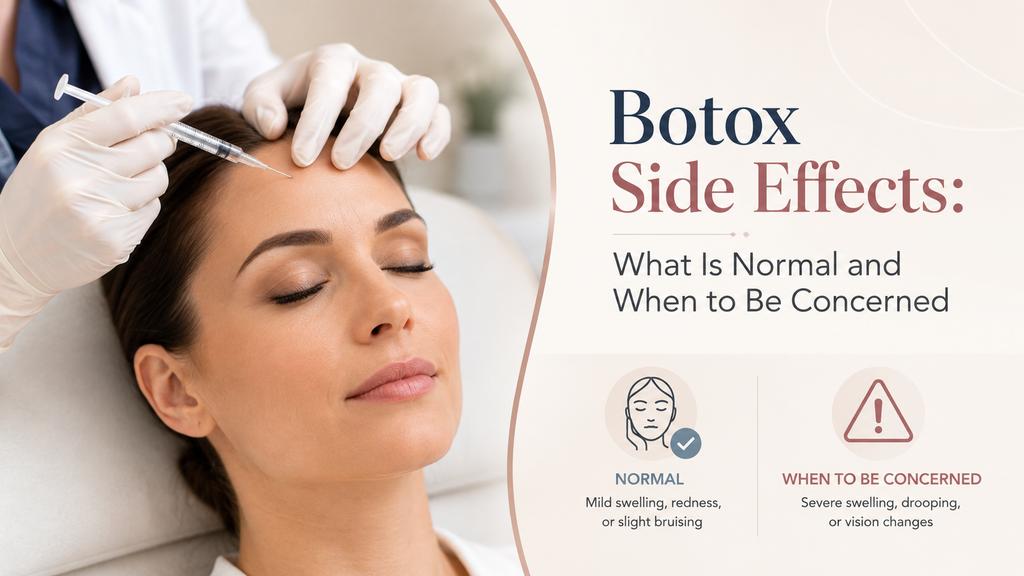
Understanding Botox Side Effects: What Is Normal and When to Be Concerned can make cosmetic treatment less confusing and help patients recognize when a reaction deserves medical attention. Most effects after cosmetic Botox are mild and temporary, such as redness, swelling, tenderness, or bruising around an injection site.
However, botulinum toxin medicines also carry important warnings about rare symptoms involving muscle weakness, swallowing, speech, or breathing.
Botox Cosmetic contains onabotulinumtoxinA, a prescription form of botulinum toxin type A. It temporarily reduces muscle activity by blocking the release of acetylcholine at the nerve and muscle connection.
What Is Botox and Why Can Side Effects Occur?
Botox works by reducing signaling between selected nerves and muscles. When injected into carefully chosen facial muscles, this temporary reduction in activity can soften dynamic lines caused by repeated expressions.
Treatment effects depend on dose, injection location, anatomy, muscle strength, technique, and individual response. This is why appropriate assessment and accurate placement are important for both cosmetic results and safety.
Anyone considering Botox and Dysport treatments should discuss medical history, previous injections, medications, neuromuscular conditions, and treatment goals with a qualified health professional beforehand.
Are Botox Side Effects Common?
Minor injection related reactions can occur after treatment. The American Academy of Dermatology states that when side effects develop, they tend to be mild and temporary, with many mild effects caused by the injection itself rather than the toxin.
Commonly reported temporary reactions include redness, swelling, soreness, and bruising. Mild headache can also occur, although the AAD describes it as uncommon in cosmetic treatment.
The type and frequency of adverse reactions also depend on the area being treated.
Botox Side Effects at a Glance
| Reaction | General level of concern | Recommended response |
| Mild redness | Usually expected | Monitor and follow provider instructions |
| Mild swelling | Usually expected | Allow time to settle |
| Small bruise | Usually expected | Monitor during healing |
| Temporary soreness | Usually expected | Avoid unnecessary pressure |
| Mild headache | Can occur | Contact the provider if persistent or severe |
| Drooping eyelid or brow | Contact provider | Requires professional assessment |
| New vision changes | Concerning | Seek prompt medical advice |
| Generalized muscle weakness | Serious warning sign | Seek medical attention promptly |
| Trouble swallowing | Serious warning sign | Seek immediate medical attention |
| Trouble speaking | Serious warning sign | Seek immediate medical attention |
| Trouble breathing | Medical emergency | Seek emergency care |
The severity and context matter. A tiny bruise at the needle site is very different from developing difficulty breathing or swallowing.
What Does FDA Safety Information Say?
The official United States prescribing information for Botox Cosmetic includes a boxed warning about distant spread of toxin effect. Symptoms consistent with botulinum toxin effects have been reported hours to weeks after injection.
The warning specifically identifies swallowing and breathing difficulty as potentially life threatening. Patients are instructed to seek immediate medical attention if respiratory, speech, or swallowing problems occur.
This warning does not mean these serious complications are expected after routine cosmetic treatment. It does mean patients should know which symptoms should never be dismissed as ordinary recovery.
Normal Redness and Swelling After Botox
Small areas of redness can develop where the needle entered the skin. Mild localized swelling can also occur immediately after treatment.
These effects are generally related to the injection process and usually improve without significant intervention. The AAD includes swelling, redness, soreness, and bruising among recognized temporary reactions following botulinum toxin treatment.
Persistent, rapidly worsening, or unusually painful swelling should be evaluated rather than automatically assumed to be normal.
Bruising After Botox
Bruising can happen when the needle affects a small blood vessel under the skin. Some patients bruise more easily than others.
The American Academy of Dermatology notes that occasional bruising can last about one week.
Patients should tell their provider about prescription medicines, nonprescription medicines, vitamins, and supplements before treatment because some products can influence bleeding or bruising risk. Medication should never be stopped solely for cosmetic treatment without appropriate medical guidance.
If concern about discomfort is preventing someone from seeking treatment, learning whether Botox hurts can also help separate normal injection sensations from symptoms that deserve attention.
Headache After Botox
Headache is a recognized adverse reaction in certain cosmetic treatment studies, although frequency depends on the treatment area.
According to current FDA prescribing information, headache occurred in 9 percent of patients in studies involving treatment of forehead lines.
A mild headache after treatment does not automatically indicate a complication. A severe, unusual, prolonged, or worsening headache should be discussed with a health professional, particularly if it occurs alongside weakness, vision changes, speaking difficulty, or other neurological symptoms.
Eyelid Drooping After Botox
Temporary eyelid drooping is known medically as eyelid ptosis. It can occur if the effect of treatment reaches a muscle responsible for lifting the eyelid.
FDA clinical trial information reports eyelid ptosis in 3 percent of patients treated for glabellar lines.
Although eyelid drooping is generally not an emergency by itself, patients should contact their treating provider. A professional can determine whether the appearance is consistent with localized muscle weakness or whether another cause should be investigated.
Brow Drooping
Brow ptosis occurs when the eyebrow sits lower than intended following treatment. This can happen when forehead muscle activity is reduced more than desired or when anatomy and injection placement interact in an unfavorable way.
In clinical studies included in the Botox Cosmetic prescribing information, brow ptosis occurred in 2 percent of patients receiving treatment for forehead lines.
This is one reason Botox dosing should be individualized rather than based solely on a standard number of units for every face.
Eyelid Swelling
The FDA prescribing information reports eyelid edema in 1 percent of patients treated for lateral canthal lines, commonly known as crow’s feet.
Mild swelling close to an injection site can occur for several reasons. However, swelling associated with breathing difficulty, throat symptoms, widespread hives, or swelling of the face or mouth can indicate a serious allergic reaction and requires urgent medical attention.
Clinical Trial Numbers for Cosmetic Botox
| Treatment area | Adverse reaction highlighted in FDA labeling | Reported frequency |
| Glabellar lines | Eyelid ptosis | 3 percent |
| Lateral canthal lines | Eyelid edema | 1 percent |
| Forehead lines | Headache | 9 percent |
| Forehead lines | Brow ptosis | 2 percent |
These figures come from clinical trial data summarized in United States prescribing information for Botox Cosmetic. They should not be interpreted as the likelihood of every possible side effect for every patient.
Treatment areas, total dose, anatomy, previous procedures, medical history, and other factors can affect individual risk.
Can Botox Cause Facial Asymmetry?
Temporary asymmetry can occur if one muscle responds differently from another or if the treatment changes facial movement unevenly.
Possible changes may include eyebrow height differences, an uneven smile, or altered movement in a nearby muscle. Mayo Clinic lists crooked eyebrows, a crooked smile, and drooling among possible unwanted effects after Botox injections.
Patients noticing unexpected asymmetry should contact their provider rather than immediately seeking additional injections elsewhere.
How Long Do Botox Side Effects Last?
There is no single timeline for every side effect.
Injection site redness or swelling may settle relatively quickly, while bruising may remain visible for several days. The AAD notes that occasional bruising can last about one week.
Muscle related effects can last longer because Botox temporarily changes muscle activity. The cosmetic effect itself typically lasts about three to four months according to AAD patient guidance, although individual duration varies.
For a fuller explanation of treatment onset, read about how long Botox takes to work.
When Should You Be Concerned After Botox?
Certain symptoms deserve prompt medical attention because they are not typical minor injection reactions.
The FDA warning identifies difficulty breathing, difficulty speaking, and difficulty swallowing as symptoms requiring immediate medical attention. Generalized weakness or symptoms suggesting the toxin has affected areas beyond the intended muscles should also be taken seriously.
Mayo Clinic similarly advises contacting a health professional promptly if muscle weakness, vision problems, trouble talking, trouble swallowing, breathing problems, allergic reactions, or loss of bladder control develop after Botox treatment.
Symptoms That Need Urgent Attention
| Symptom | Why it matters |
| Difficulty breathing | May reflect serious systemic muscle effects or an allergic reaction |
| Difficulty swallowing | Can indicate spread of toxin effect |
| Difficulty speaking | Can indicate unwanted neuromuscular effects |
| Generalized muscle weakness | Can indicate effects beyond the injection area |
| Severe allergic symptoms | Can become life threatening |
| Significant vision changes | Require prompt assessment |
| Loss of bladder control with weakness | Listed among possible serious systemic symptoms |
Serious reactions can occur hours to weeks after injection, according to FDA prescribing information.
Patients should therefore not assume that a symptom is unrelated simply because it did not begin on the day of treatment.
What About Allergic Reactions?
Serious allergic reactions are possible with medicines containing onabotulinumtoxinA.
Signs can include rash, itching, swelling of the face or mouth, hoarseness, difficulty swallowing, or difficulty breathing. Mayo Clinic advises immediate medical attention when symptoms suggest a serious allergic reaction.
Breathing difficulty or severe swelling should be treated as an emergency rather than managed through routine aftercare at home.
Who May Have a Higher Risk of Complications?
Certain medical conditions can increase concern when botulinum toxin is being considered.
FDA prescribing information advises caution in people with preexisting neuromuscular disorders because the clinical effects of treatment can be increased. It also advises caution in patients with compromised respiratory function or existing swallowing difficulty.
Mayo Clinic lists conditions such as myasthenia gravis, Lambert Eaton syndrome, motor neuropathy, breathing disorders, swallowing problems, and certain other medical histories as factors that may require additional caution.
A detailed consultation is therefore part of safe treatment, not just a discussion about wrinkle location.
What Should You Tell Your Provider Before Botox?
Provide a complete history of medical conditions, medications, previous botulinum toxin treatments, facial procedures, allergies, and current symptoms.
You should also mention any history of difficulty swallowing, speaking, or breathing, as well as conditions that affect nerves or muscles.
The American Academy of Dermatology emphasizes that safe injection requires detailed medical knowledge and recommends choosing an appropriately trained professional.
What Should You Avoid Immediately After Treatment?
Patients should follow instructions from the treating professional because aftercare may vary according to the treatment area and medical history.
The AAD recommends avoiding rubbing or massaging injected areas and being gentle when applying makeup. It also advises waiting two hours before strenuous physical activity.
These recommendations are intended to reduce unnecessary pressure and help prevent movement of the injected substance into unwanted areas.
Are Botox Side Effects Permanent?
Most minor side effects associated with cosmetic botulinum toxin treatment are temporary.
Bruising, redness, soreness, and mild swelling generally resolve. Temporary weakness of a nearby muscle can take longer because recovery depends on the return of muscle activity.
Permanent complications are not expected outcomes of appropriate cosmetic Botox treatment. However, serious adverse reactions are possible, which is why severe neurological, respiratory, swallowing, or allergic symptoms require medical assessment.
Is Botox Generally Considered Safe?
Botox has an established history of medical and cosmetic use. Safety, however, depends on appropriate patient selection, authentic medication, proper dosing, anatomical knowledge, and professional injection technique.
The AAD notes that millions of patients receive botulinum toxin treatment and emphasizes that expertise plays an important role in safe treatment.
People researching cosmetic services can learn more about treatment options and professional skin care through World of Beauty Miami.
Frequently Asked Questions
Is redness after Botox normal?
Mild localized redness can occur after injection and is usually temporary. Increasing redness accompanied by significant pain, warmth, fever, or other concerning symptoms should be evaluated.
Is bruising normal after Botox?
Yes, minor bruising can occur. The AAD notes that occasional bruising may last around one week.
Is eyelid drooping dangerous?
Temporary eyelid ptosis is a recognized Botox Cosmetic adverse reaction. FDA clinical trial data reported it in 3 percent of patients receiving treatment for glabellar lines. Contact the treating provider for assessment.
When should I seek emergency help?
Seek immediate medical care if you develop difficulty breathing, swallowing, or speaking. Severe allergic symptoms or rapidly progressing generalized weakness also require urgent attention.
Can Botox cause a headache?
Yes. Headache is a recognized adverse reaction. FDA trial data for forehead line treatment reported headache in 9 percent of patients.
Can Botox side effects appear later?
Yes. The FDA boxed warning states that symptoms related to distant spread of toxin effect have been reported from hours to weeks after injection.
Final Thoughts
Most cosmetic Botox side effects are minor and temporary. Localized redness, swelling, soreness, and bruising can occur because treatment involves several small injections into targeted areas.
Other effects such as eyelid or brow drooping require contact with the treating professional but are not the same as emergency symptoms. Understanding that distinction can prevent both unnecessary worry and dangerous delays in seeking medical care.
Difficulty breathing, swallowing, or speaking, generalized muscle weakness, significant vision problems, and symptoms of a severe allergic reaction should never be treated as routine Botox recovery. The FDA specifically warns that distant toxin effects can appear hours to weeks after treatment and may become serious.
Choosing an appropriately qualified provider, sharing an accurate medical history, receiving authentic prescription medication, and following professional aftercare instructions are among the most important steps for reducing avoidable risk.