Knowing how to add peptides to a skincare routine starts with understanding what peptides actually do and where they fit among cleansers, moisturizers, sunscreen, retinoids, and other active ingredients.
Peptides are short chains of amino acids, the building blocks used to form proteins such as collagen and elastin. In cosmetic formulas, specific peptides are used with the goal of supporting hydration, skin barrier function, firmness, texture, and the appearance of fine lines.
Research on topical peptides is promising, but results vary significantly by peptide type, formulation, concentration, and study quality. Peptides are not a replacement for sunscreen or evidence based treatments such as retinoids. They are better viewed as one component of a well designed skincare routine.
What Are Peptides in Skincare?
Peptides are made from amino acids joined together in short chains. Proteins are larger structures containing many amino acids, while peptides contain smaller sequences.
The skin naturally contains proteins that contribute to structure and function. Cosmetic researchers have developed peptides intended to interact with processes related to skin appearance, hydration, barrier support, and extracellular matrix activity.
Not every peptide performs the same function.
| Peptide category | General purpose studied in skincare |
| Signal peptides | Associated with processes involved in extracellular matrix support |
| Carrier peptides | Designed to transport certain trace elements |
| Enzyme related peptides | Studied for effects on processes involved in skin aging |
| Neurotransmitter related peptides | Used in cosmetic formulas intended to soften the appearance of expression lines |
| Barrier focused peptides | Formulated to support hydration and skin barrier quality |
These categories describe proposed or studied functions. They do not mean every product containing a peptide will produce the same clinical result.
The complete formula matters just as much as the ingredient name.
What Does Research Say About Peptides for Skin?
Recent research provides useful context.
A 2026 systematic review and meta analysis evaluated 19 randomized controlled trials involving 1,341 participants who used oral or topical peptide interventions for skin aging. Overall, peptide interventions showed improvements in some measures of hydration and brightness, with a modest pooled effect on wrinkle reduction.
The researchers noted that much of the wrinkle benefit was driven by oral polypeptide studies and called for larger standardized trials.
This is important because the term “peptides” covers many different compounds.
A positive study involving one specific peptide cannot automatically prove that every peptide serum or cream will provide the same benefit.
Selected Peptide Research
| Study | Participants | Duration | Main finding |
| Palmitoyl pentapeptide trial | 93 women | 12 weeks | Improvement in measurements of facial fine lines and wrinkles compared with control |
| Acetylhexapeptide and palmitoyl pentapeptide trial | 21 women | 8 weeks | Palmitoyl pentapeptide showed better results on several measures than comparison groups |
| OS 01 topical peptide trial | 60 women | 12 weeks | Improved skin barrier function and hydration compared with moisturizer control |
| 2026 systematic review | 1,341 participants across 19 trials | Varied | Some benefits found, but outcomes and peptide formulations differed substantially |
The 2005 randomized trial involving 93 women tested a moisturizer containing 3 parts per million of palmitoyl pentapeptide against the moisturizer alone for 12 weeks. The peptide formulation produced statistically significant improvements in measures of fine lines and wrinkles.
A much smaller 2023 randomized trial involving 21 women also found improvement with certain topical peptides around the eyes, although the small sample size limits how broadly those findings can be applied.
Where Should Peptides Go in a Skincare Routine?
The correct position depends mainly on the type of peptide product.
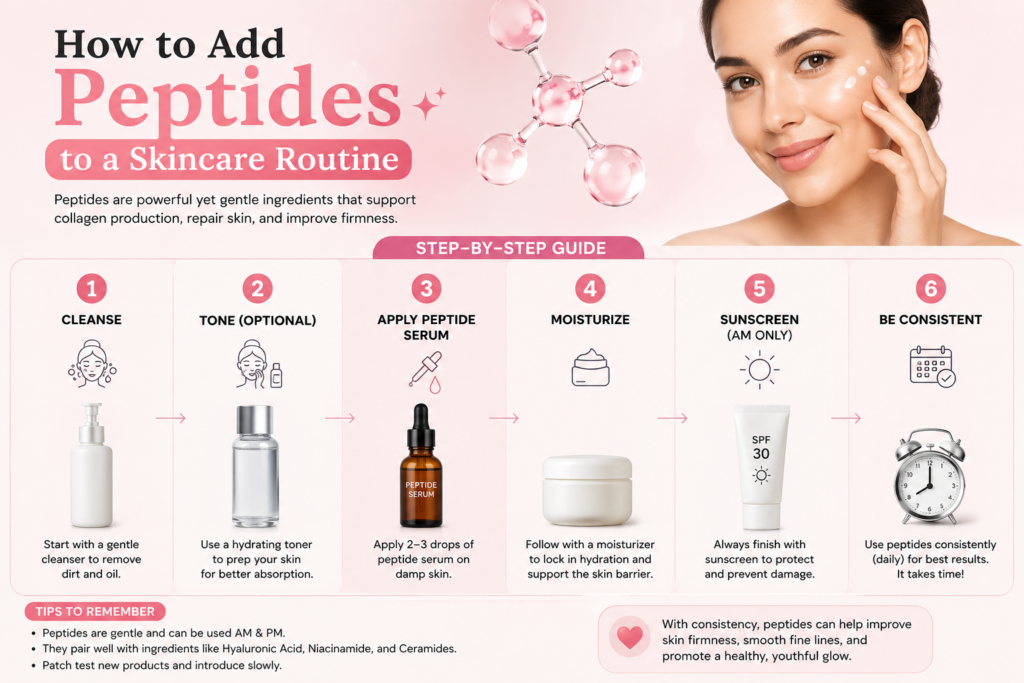
A lightweight peptide serum generally goes after cleansing and before a heavier moisturizer. A peptide moisturizer usually replaces the standard moisturizer step rather than being layered underneath another cream.
A simple routine may look like this:
| Order | Morning | Evening |
| 1 | Gentle cleanser | Gentle cleanser |
| 2 | Treatment serum if used | Treatment product if used |
| 3 | Peptide serum | Peptide serum |
| 4 | Moisturizer | Moisturizer |
| 5 | Broad spectrum SPF 30 or higher | Not required during sleep |
Product directions should always take priority because formulations differ.
Some peptide ingredients are delivered in water based serums, while others are incorporated into creams containing moisturizers, lipids, antioxidants, or additional active ingredients.
Step 1: Start With a Gentle Cleanser
Peptides do not require complicated preparation.
Begin with a cleanser appropriate for your skin type. Cleansing removes sunscreen, makeup, oil, pollutants, and other substances that may accumulate on the skin.
Avoid aggressively scrubbing the face before applying skincare products.
Excessive cleansing and harsh exfoliation can irritate the skin barrier. Irritation can make an otherwise reasonable skincare routine difficult to tolerate.
People who regularly use professional skincare treatments may also benefit from understanding how treatments complement daily maintenance. World of Beauty offers several facial services in Miami designed around individual skin concerns.
Step 2: Apply Lightweight Products Before Heavy Products
A useful general rule is to apply lighter formulas before heavier creams.
If your peptide comes in a thin serum, it will usually be applied after cleansing and before moisturizer. This allows the serum to spread evenly across clean skin without needing to move through a heavier occlusive layer first.
You generally need only enough product to cover the intended area according to the manufacturer’s directions.
Applying dramatically more product does not necessarily improve results and may increase cost or irritation from other ingredients included in the formula.
Step 3: Follow With Moisturizer
Moisturizer is an important part of almost every routine.
The American Academy of Dermatology notes that moisturizing traps water in the skin and can temporarily reduce the appearance of some fine lines while helping the complexion look smoother.
This can complement a peptide serum.
Some peptide products already contain moisturizing ingredients. In that situation, a separate cream may not always be necessary for oily skin, while dry skin may benefit from an additional moisturizer.
Skin type should guide the decision.
Step 4: Use Sunscreen Every Morning
If improving signs of skin aging is the goal, sunscreen is more fundamental than a peptide serum.
Ultraviolet exposure contributes to premature skin aging, pigmentation changes, and wrinkles. The American Academy of Dermatology recommends a broad spectrum sunscreen with an SPF of at least 30 as part of an anti aging skincare strategy.
Use sunscreen as the final skincare step in the morning before makeup.
Peptides cannot reverse the consequences of continued unprotected ultraviolet exposure.
A practical routine therefore protects the skin first and adds cosmetic ingredients second.
Morning Peptide Routine
A simple morning routine can remain surprisingly short.
Cleanser
Wash with a gentle cleanser that does not leave the skin feeling excessively tight or dry.
Peptide Serum
Apply the peptide product according to its directions.
Allow it to spread evenly across the areas you want to treat.
Moisturizer
Use a moisturizer appropriate for your skin type.
People with dry skin may prefer richer creams, while oily skin may tolerate lighter lotion or gel formulas better.
Sunscreen
Finish with broad spectrum SPF 30 or higher.
Sunscreen should not be replaced by makeup unless the makeup provides adequate broad spectrum protection and is applied in an appropriate amount.
Evening Peptide Routine
The evening routine provides another opportunity to use peptides.
A basic schedule might include cleansing, a treatment product where appropriate, peptide serum, and moisturizer.
If several active products are already being used, adding everything at once is not ideal.
Introducing products individually makes it easier to determine which ingredient causes irritation if a reaction develops.
Can You Use Peptides Every Day?
Many cosmetic peptide products are designed for daily use, sometimes once or twice per day.
The correct frequency depends on the complete formulation rather than peptides alone.
A serum containing a gentle peptide and moisturizing ingredients may be comfortable twice daily. Another product may include additional ingredients that require a different schedule.
Follow the label and reduce frequency if irritation occurs.
More frequent application is not automatically better.
Can Peptides Be Used With Retinol?
Peptides and retinol can be included in the same overall skincare routine for many people.
They address skin concerns through different mechanisms. Retinoids have substantial evidence supporting improvements in fine lines, pigmentation, texture, and collagen related skin changes. The American Academy of Dermatology notes that retinoids can increase surface skin cell turnover and support collagen production.
People new to retinol should introduce it gradually because irritation and dryness can occur.
A simple evening routine could involve retinol followed by moisturizer, with the peptide serum used in the morning. Another option may be using both during the evening if the formulas are compatible and well tolerated.
There is rarely a need to create an excessively complicated routine.
Can Peptides Be Used With Vitamin C?
Peptide products and vitamin C products can often exist within the same skincare plan.
Compatibility depends on the exact peptide, vitamin C formulation, pH, stabilizing ingredients, and product instructions.
If using both causes irritation or excessive layering, separating them may be easier.
For example, vitamin C can be used in the morning while peptides are used at night.
There is no universal requirement that every beneficial skincare ingredient be applied in the same session.
Can Peptides Be Used With Hyaluronic Acid?
Yes, these ingredients are frequently found together.
Hyaluronic acid is primarily valued for hydration because of its ability to bind water. Peptides are included for different cosmetic goals depending on their structure.
Using the two together can therefore make sense for people concerned about both hydration and signs of aging.
In fact, many commercial peptide products already contain humectants and moisturizing ingredients.
What About Peptides and Exfoliating Acids?
People using glycolic acid, salicylic acid, or other exfoliating acids should focus on overall skin tolerance.
There is no benefit in building a routine so aggressive that the skin becomes persistently irritated.
If an exfoliating product already causes dryness, use it on selected evenings and apply a simpler peptide and moisturizing routine at other times.
This is particularly relevant for people receiving professional treatments such as chemical peels.
Peptides and Microneedling Are Not the Same Treatment
Topical peptide skincare and professional microneedling should not be confused.
A topical serum sits within a daily skincare routine. Microneedling creates controlled microscopic injuries in the skin and is used professionally to address concerns such as texture and selected scars.
Products used immediately after a procedure require careful selection because the skin barrier has been intentionally disrupted.
Anyone undergoing professional treatment should follow the provider’s aftercare instructions rather than automatically applying the same home products. Readers considering the procedure can learn more about what microneedling involves before adding it to a skincare plan.
How Long Do Peptides Take to Work?
Peptide skincare should not be evaluated after a few days.
Clinical studies that found measurable changes generally evaluated participants over several weeks.
For example, the palmitoyl pentapeptide study involving 93 participants lasted 12 weeks. The 2023 crow’s feet peptide study lasted eight weeks.
The practical lesson is consistency.
Take a baseline photograph in similar lighting and compare your skin after eight to twelve weeks rather than trying to detect small daily changes.
Even then, remember that changes can result from the complete skincare routine rather than the peptide alone.
What Results Can You Realistically Expect?
Peptides should not be marketed as a substitute for cosmetic procedures or prescription treatments.
A well formulated peptide product may support improvements in hydration, texture, firmness, barrier function, or the appearance of fine lines depending on its ingredients.
Results are usually subtle.
| Goal | Realistic expectation |
| Hydration | May improve with a well formulated moisturizing product |
| Fine lines | Some specific peptides have shown modest improvements |
| Skin firmness | Possible improvement with certain formulations |
| Deep wrinkles | Topical peptides are unlikely to erase established deep wrinkles |
| Facial volume loss | Peptide serum cannot replace lost structural volume |
| Significant skin laxity | Requires professional evaluation |
| Sun protection | Peptides cannot replace sunscreen |
The 2026 meta analysis is useful here because it found a modest overall wrinkle effect and inconsistent findings for measures such as elasticity and skin density.
That is much more realistic than claims promising dramatic facial transformation.
How to Choose a Peptide Product
Start with the ingredient list rather than the marketing language.
Look for a product from a reputable manufacturer that clearly identifies its intended use and provides application instructions.
Common peptide names may include palmitoyl pentapeptide, copper related peptides, acetyl hexapeptides, and other proprietary peptide complexes.
A longer ingredient list does not necessarily mean a better product.
The vehicle containing the peptide matters because stability and delivery influence whether an ingredient can meaningfully interact with the skin.
Patch Test Before Using a New Product
Even ingredients considered gentle can be part of formulations containing preservatives, fragrances, botanical extracts, or other substances that cause irritation.
The American Academy of Dermatology recommends testing skincare products before incorporating them fully into a routine. One suggested approach involves applying a small amount to a test area twice daily for several days and watching for a reaction.
Stop using a product if you develop significant burning, swelling, itching, blistering, or a persistent rash.
People with eczema, rosacea, allergies, or other skin disorders may benefit from consulting a dermatologist before introducing several new products.
When Professional Peptide Treatments May Be Considered
Home skincare and professional aesthetic treatments are different approaches.
A topical peptide serum is designed for routine cosmetic use. Professional peptide treatments may use different products, delivery methods, concentrations, or protocols.
World of Beauty Miami provides professional peptide treatments for clients seeking support with the appearance of texture, hydration, firmness, and overall skin quality.
A consultation can help determine whether home care, professional treatment, or another option better matches the concern being treated.
Common Mistakes When Adding Peptides
One common mistake is expecting immediate wrinkle removal.
Another is adding peptide serum, retinol, acids, vitamin C, exfoliating masks, and several new products simultaneously.
When irritation develops, there is no easy way to identify the cause.
A better method is gradual introduction.
Another mistake is investing heavily in treatment products while neglecting sunscreen. Consistent ultraviolet protection has a stronger established role in preventing premature visible skin aging than cosmetic peptide products.
A Simple Routine by Skin Goal
| Skin concern | Morning | Evening |
| Dryness | Cleanser, peptide serum, moisturizer, sunscreen | Cleanser, peptide serum, rich moisturizer |
| Fine lines | Cleanser, peptide serum, moisturizer, sunscreen | Cleanser, appropriate retinoid, moisturizer |
| Sensitive skin | Gentle cleanser, moisturizer, sunscreen | Gentle cleanser, peptide product if tolerated, moisturizer |
| Uneven texture | Cleanser, peptide serum, sunscreen | Cleanser, targeted treatment on selected nights, moisturizer |
| Basic prevention | Cleanser, moisturizer, sunscreen | Cleanser, peptide serum, moisturizer |
Individual needs vary, especially when acne, rosacea, eczema, pigmentation, or prescription treatment is involved.
For people seeking a personalized professional skincare approach, World of Beauty Miami offers aesthetic services based on individual skin goals and treatment needs.
Frequently Asked Questions
What step should peptides be in a skincare routine?
A lightweight peptide serum usually goes after cleansing and before moisturizer. If the peptide is already included in a moisturizer, use it during the moisturizing step.
Product directions should take priority.
Should peptides be used morning or night?
Many peptide skincare products can be used in either the morning or evening.
Some are formulated for twice daily use. Check the product instructions and consider the rest of your routine.
Can I use peptides every day?
Many topical peptide products are suitable for daily use when well tolerated.
Frequency depends on the entire formulation, skin sensitivity, and other active products being used.
Can I use peptides with retinol?
Many people can use both within the same skincare routine.
Because retinoids can cause irritation, beginners may prefer retinol at night and peptides in the morning while their skin adjusts.
Can peptides replace retinol?
No.
Peptides and retinoids are different ingredients with different levels of supporting evidence and mechanisms. Retinoids have a particularly established role in treating photoaging and fine lines.
How long should I use peptides before judging the results?
Give a well tolerated product several weeks of consistent use.
Several clinical peptide studies assessed outcomes after eight to twelve weeks rather than after a few days.
Do peptide serums really work?
Some specific topical peptides have demonstrated measurable benefits in controlled studies, including improvements in fine lines, hydration, or barrier measures. The evidence does not prove that every peptide product will work equally well.
Are peptides good for sensitive skin?
Peptides themselves may be well tolerated in many formulations, but sensitive skin can react to other ingredients in the same product.
Patch testing and gradual introduction are sensible approaches.
Building a Smarter Peptide Skincare Routine
Adding peptides does not require rebuilding your entire skincare routine.
Start with the essentials. Cleanse gently, moisturize appropriately, and protect the skin every morning with broad spectrum SPF 30 or higher. Add a peptide serum between cleansing and moisturizing if it fits your goals and skin tolerance.
Give the product enough time to evaluate it fairly.
Studies of individual topical peptides have reported benefits after approximately eight to twelve weeks, while the broader research shows that results vary according to the specific peptide and formulation.
Most importantly, keep expectations realistic.
Topical peptides may support healthier looking skin, hydration, texture, firmness, and modest improvement in some fine lines. They cannot replace sunscreen, restore significant facial volume, erase deep wrinkles, or duplicate the results of professional procedures.
A successful skincare routine is not the one containing the greatest number of ingredients. It is the one that addresses your actual concerns, protects the skin consistently, avoids unnecessary irritation, and uses products supported by a reasonable level of evidence.